There’s a particular kind of betrayal that doesn’t feel like a knife.
It feels like a handshake.
Warm. Steady. Lingering just a second too long.
The kind that says, We’re in this together.
That’s how it started.
She bought the coffee. She leaned in close over the file folders, lowering her voice when she said, “You can trust me.” She shared just enough truth to make the lie feel solid. She spoke about integrity. About cleaning house. About doing the right thing.
Mara Kincaid believed her.
That was the first mistake.
Backstabbing isn’t loud. It doesn’t arrive with shouting or dramatic confessions. It moves quietly, in sensible shoes, with perfectly chosen words and a reassuring smile. It builds trust brick by brick until you can’t remember when you started relying on it.
Then, one day, the air shifts.
The hallway seems longer than it should be.
The exit sign hums a little too loudly.
And the door behind you clicks shut.
Mara had thought she was building something — a case strong enough to split open the rot beneath the precinct. She thought she had an ally inside the system. A woman willing to risk her badge to expose what was festering under polished floors and framed commendations.
She nodded at all the right moments.
She agreed at all the right times.
She even warned Mara, once, to be careful.
That should have been the tell.
Because when the truth sharpened into something dangerous — something that could cost careers, pensions, freedom — the woman didn’t stand beside her.
She stepped back.
And that’s when they emerged.
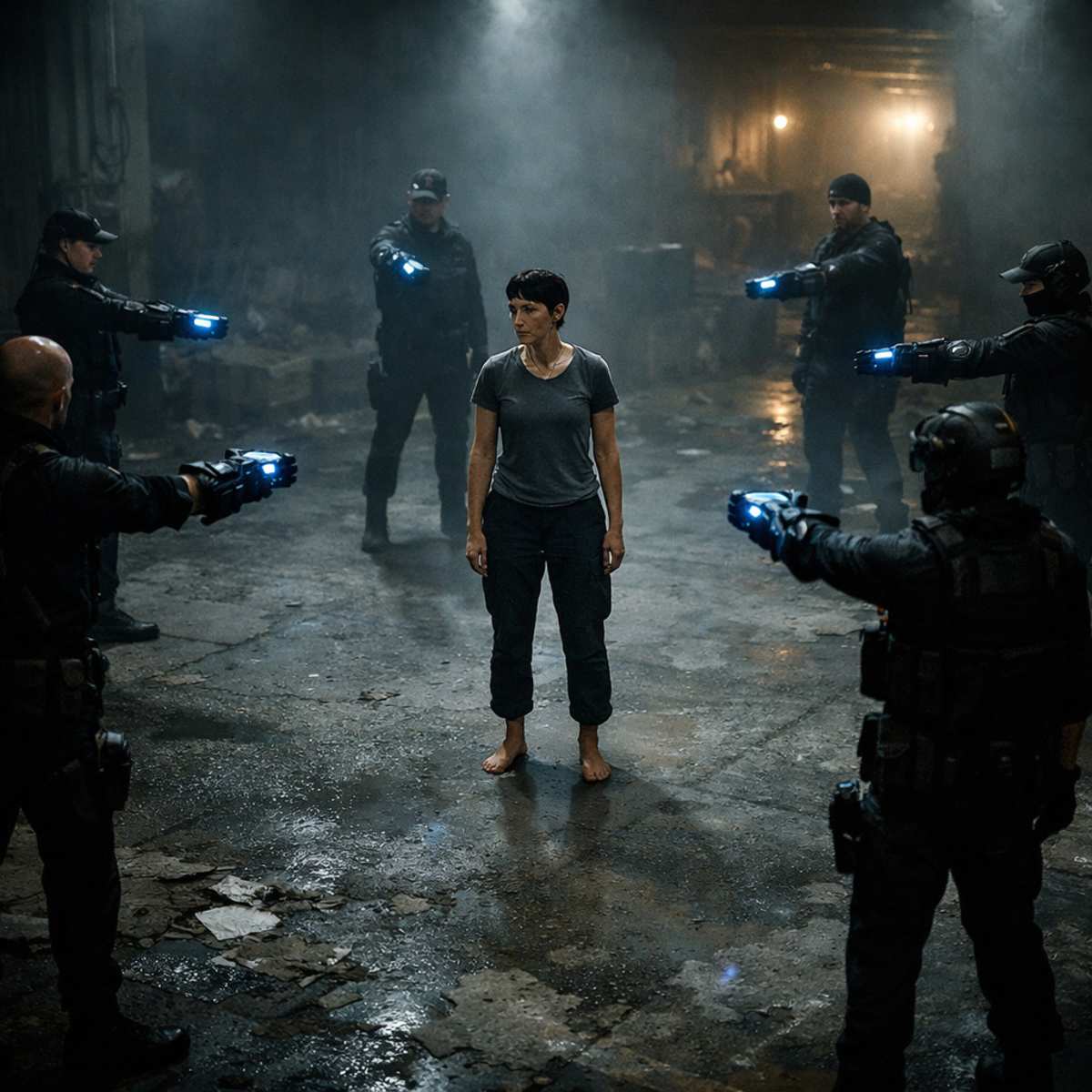
Six operatives.
Calm. Precise. Moving with rehearsed efficiency. Not rushing. Not angry. Just doing a job.
They formed a circle around Mara — shoulders squared, spacing exact, hands relaxed but ready. A tightening perimeter.
One woman to contain.
One problem to neutralize.
One threat to bury.
Mara didn’t panic. Panic wastes oxygen. She counted them instead. Calculated weight, stance, dominant sides. Measured the distance between wrists and holsters. Even surrounded, her mind ticked like a metronome.
But betrayal isn’t about strength.
It’s about timing.
By the time you realize the trap was laid weeks ago, you’re already standing in it.
The worst part?
The woman who betrayed her didn’t look cruel.
She looked composed.
Almost sympathetic.
Like someone who had made a difficult but necessary decision.
That’s the horror of it.
Betrayal doesn’t always come from enemies. Enemies glare. They posture. They show their teeth.
Betrayal comes from someone who shared your table. Who knew your blind spots because you showed them. Who shook your hand and meant every word — until meaning it became inconvenient.
In The Evidence Locker: A Dark Mystery Thriller, Mara Kincaid discovers that corruption isn’t just systemic.
It’s personal.
It smiles at you across a desk.
It promises partnership.
And when the truth becomes too dangerous to hold, it hands you over to the people who specialize in making problems disappear.
The scariest part of being surrounded by six operatives isn’t the circle.
It’s realizing the person who led you there is standing just outside it.
Watching.
The Evidence Locker is coming soon.
And this time, the evidence isn’t the only thing that gets locked away.
Trust does, too.