The opening of Battleship (2012) wastes no time establishing its central idea: something has arrived, and it did not come quietly.
The sequence begins with what looks, at first glance, like a familiar cinematic event. A blazing object tears through the upper atmosphere, trailing fire and friction, the kind of visual shorthand audiences have been trained to read as “meteor.” It burns hot, violent, and uncontrolled. But there’s a subtle difference in how the camera lingers. This isn’t just debris. There’s intent buried in the motion, something slightly too precise for pure chance.


The descent is fast. The object doesn’t drift or fragment like natural space rock. It cuts through the sky on a deliberate trajectory, a line drawn rather than a fall surrendered to gravity. The sound design reinforces that unease. Instead of the chaotic roar of disintegration, there’s a sustained, almost mechanical presence beneath the noise, as if something is holding together under impossible stress.
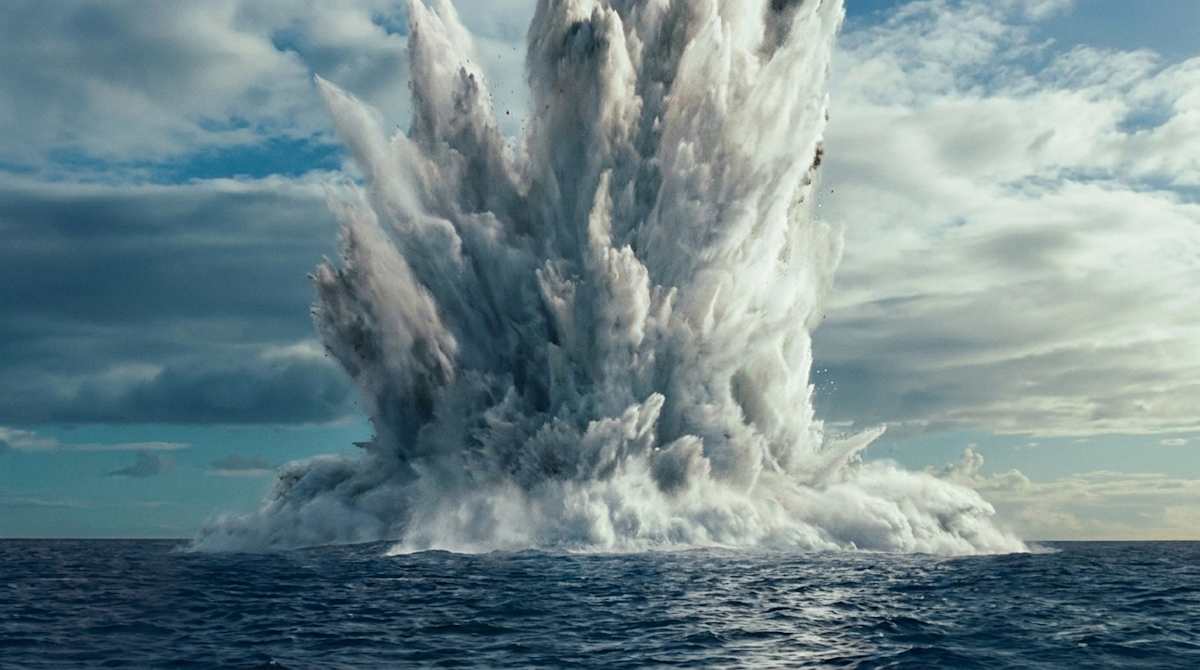
When it hits the ocean, the film leans fully into scale. The impact is not just a splash, it’s an event. Water erupts upward in a towering column, the surface rupturing like it’s been struck by a weapon rather than a falling stone. The shockwave rolls outward, distorting the calm of the surrounding sea. It’s the kind of impact that doesn’t just disturb the environment, it announces itself.
And that’s the point. The ocean, usually a buffer between unknown depths and human control, becomes the stage for first contact. Not a quiet landing. Not a hidden arrival. A violent insertion.
What makes the moment work isn’t complexity, it’s clarity. The filmmakers understand that first contact, at least in this story, isn’t about conversation. It’s about intrusion. The object doesn’t ask permission. It doesn’t disguise itself. It arrives with force, immediately reframing the ocean as contested space.
There’s also a tonal decision being made here that carries through the rest of the film. By presenting the alien technology as something that can survive atmospheric entry intact, the story establishes a key rule: whatever sent this object is operating at a level of engineering beyond human reach. This isn’t fragile. This isn’t exploratory in the gentle sense. It’s durable, intentional, and built to endure violence.
The visual language supports that idea. The glow around the object isn’t just heat, it feels contained, almost shielded. The structure beneath the flames never fully reveals itself, but it also never looks like it’s coming apart. The implication is clear: the fire is incidental. The object is the constant.
There’s a quiet narrative trick happening too. By disguising the alien craft as a meteor for those first seconds, the film mirrors how humanity would realistically interpret the event. People don’t look up and assume aliens. They look up and assume nature. That misread buys the story a moment of tension, the gap between what it appears to be and what it actually is.
Once the object disappears beneath the surface, the scene leaves behind a lingering question rather than an immediate answer. The ocean closes over it, but the disturbance remains. Something is down there now. Something intact.
And that restraint matters. The film doesn’t rush to reveal the alien presence in full. Instead, it lets the implication sit. The audience knows more than the characters at this point, but not enough to feel comfortable. That imbalance drives curiosity forward.
From a storytelling perspective, the opening scene does exactly what it needs to do. It sets scale, establishes threat, and introduces the core conflict without a single line of exposition. No one explains what just happened. The visuals do the work.
It also taps into a deeper, almost instinctive fear. The ocean is already one of the least understood environments on Earth. By placing the unknown beneath it, the film compounds that uncertainty. We’re not just dealing with aliens. We’re dealing with aliens hidden in a place we barely understand ourselves.
The result is an opening that feels simple on the surface but is carefully constructed underneath. A falling object. A violent impact. A hidden presence.
First contact, not as discovery, but as arrival under pressure.
And the pressure never really lets up after that.