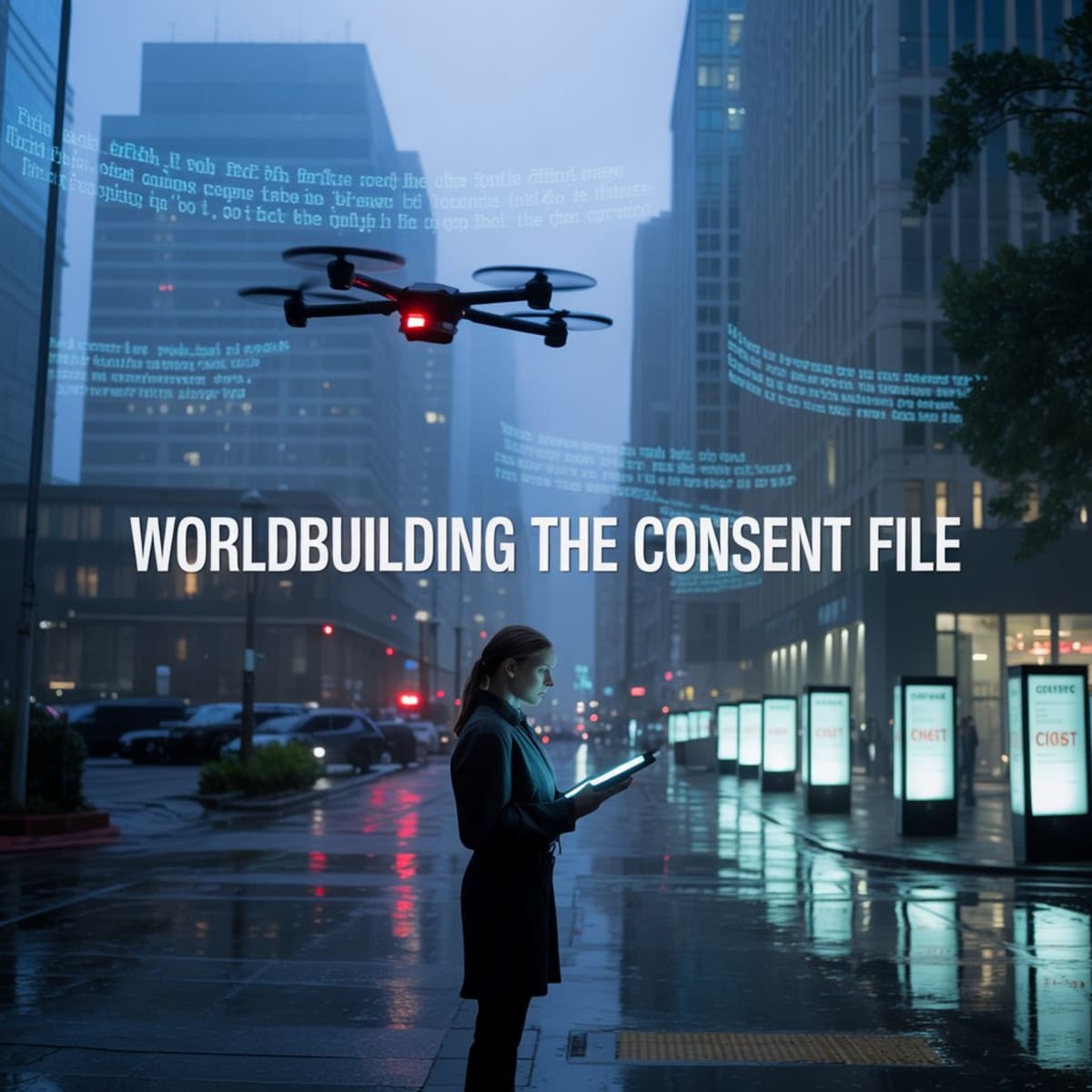
When I started building the world of The Consent File, I didn’t want a shiny sci-fi skyline or a cartoon dystopia with jackbooted guards on every corner. That’s too easy. Too safe.
I wanted a world that looked like ours on a Tuesday afternoon.
The coffee shops are still open. The rain still slicks the sidewalks. The news still hums in the background while someone scrolls through their phone and taps I Agree without reading a word.
Only in this America, consent isn’t paperwork.
It’s oxygen.
And someone else controls the air.
Lore: The Scars Beneath the System
Every haunted house has a foundation. Every system has a moment when it went wrong.
In The Consent File, that moment is the Transparency Riots of 2027.
I kept asking myself: what would it take for people to finally snap? Not grumble. Not tweet. Snap.
The answer wasn’t one villain. It never is. It was accumulation. Years of harvested data. Lives nudged and shaped by algorithms that knew your weaknesses better than your mother did. When the revelations hit—when people realized how deeply they’d been measured, predicted, and quietly steered—the streets filled.
Fires burned. Servers went dark. Politicians promised reform with trembling hands.
Out of that chaos came the Department of Digital Autonomy. And later, the crown jewel: ConsentChain.
It was supposed to be liberation. A ledger that proved your permissions. A fortress protecting your choices.
But fortresses can face inward.
ConsentChain became a cathedral of fine print. A maze where freedom was technically intact—if you could decode the language. If you had time. If you understood what you were trading away.
Then came the NetCorp Massacre. The Verification Killings.
Each horror justified another layer of oversight. Another camera. Another “temporary” expansion of authority.
That’s how systems grow. Not with a roar.
With paperwork.
For Elara Knox, the past isn’t backstory. It’s a pressure system. Every crime scene she steps into has roots in those riots, those reforms, those compromises. The violence in the present is just the echo of decisions made in conference rooms years ago.
And the scariest part?
Everyone signed.
Setting: Surveillance as Landscape
The city in The Consent File isn’t Blade Runner. It’s not neon and flying cars.
It’s worse.
It’s plausible.
There are cameras, yes. Drones humming like patient insects. Biometric checkpoints that blink green when you’re acceptable and red when you’re not. Consent Kiosks glow a cold blue in subway stations, offering “updates” to your permissions the way vending machines offer soda.
But the real surveillance isn’t in the hardware.
It’s in the normalization.
The corporate towers—glass, elegant, immaculate—are data citadels. Inside, consent packages are traded like pork futures. Brokers move access to identity, behavior, preference. Your hesitation before clicking. Your pause on a photograph. Your late-night search history. All of it has a price.
And then there are the Compliance Archives.
Cold. Sterile. Endless.
Rows of agreements no one remembers signing. Contracts that outlived the people who clicked them. Memory turned into liability and filed away under fluorescent light.
But even in a watched world, there are shadows.
Rain-soaked alleys where cameras malfunction. Dead zones carved out by old infrastructure and newer rebellion. Safe houses lined with signal-blocking paint. Communities that believe invisibility is the last remaining luxury.
In those blind spots, people breathe differently.
Not because they’re safe.
Because they’re briefly uncounted.
Religions: Faith in the Age of Consent
One of the strangest things that happened while writing this book was realizing that surveillance doesn’t kill faith.
It mutates it.
In a world where every act is logged, belief becomes data-aware.
The Church of the Open Ledger believes salvation comes through radical transparency. They confess publicly—not just sins, but search histories. Location trails. Purchase records. They treat exposure as purification. If nothing is hidden, nothing can be weaponized.
It sounds noble.
It also sounds like surrender.
On the opposite end is the Order of the Silent Circuit. They gather in Faraday-shielded rooms. They fast—not from food, but from connectivity. No devices. No signals. No metadata. They pray in the static between transmissions.
To them, privacy is sacred ground. To be unrecorded is to be holy.
And then there are the Consentarians.
They believe contracts are spiritual artifacts. Every digital signature a shard of the soul. They prepare before signing the way some people prepare for communion. Ritual washing of hands. Spoken affirmations. Witnesses.
Because if a signature binds you legally, maybe it binds you metaphysically too.
Maybe every checkbox is a vow you don’t remember making.
Why This World Feels So Close
I didn’t build The Consent File to predict the future.
I built it to tilt the present by a few degrees and see what fell out.
We already live in a world of dashboards and disclosures. We already trade convenience for access. We already carry devices that can open our bank accounts, our homes, our cars, our lives.
Convenience is never advertised as control.
It’s advertised as ease.
The horror in this book isn’t forged signatures. It’s authentic ones. Valid. Time-stamped. Verified.
The question at the heart of Elara Knox’s world isn’t just “What did you agree to?”
It’s worse.
It’s this:
If every choice is recorded…
If every hesitation is monetized…
If every agreement becomes a weapon…
What and who do you become?