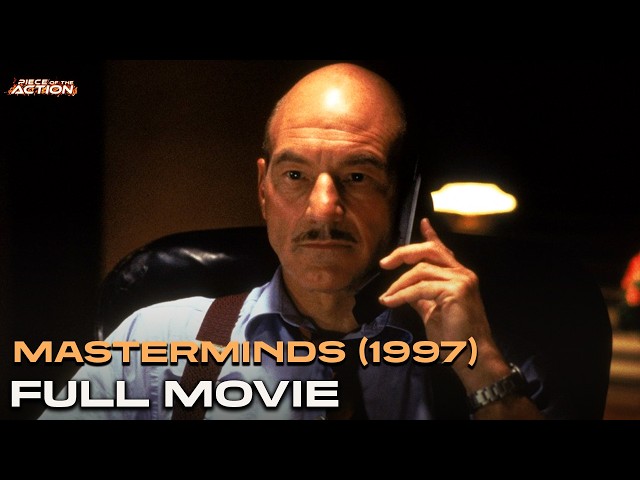
There’s a certain kind of thriller that doesn’t age out. You can watch the full movie below.
Not because it predicted the future perfectly, but because it understood something deeper about control.
Masterminds (1997) isn’t usually filed under techno-thrillers. It came out in the late ’90s, carries a lighter tone, and wraps its story around a prep school hostage situation. On the surface, it plays like a contained action story with a teenage protagonist.
But underneath that, there’s something more interesting happening.
A system gets taken over.
And once it does, everything inside it becomes a weapon.
The Setup: A Closed System Under New Ownership
The story centers on a prep school—controlled, structured, predictable. A place built on routine and hierarchy.
That’s exactly why it works.
When the antagonist, played by Patrick Stewart, seizes control of the school, he doesn’t just bring guns.
He brings access.
Security systems. Surveillance feeds. Communication lockdown. Movement control.
The school stops being a place.
It becomes an environment.
And the environment answers to him.
That’s the shift that gives the movie its edge. Not the hostage situation itself, but the idea that once a system is compromised, everyone inside it is operating on rules they no longer understand.
The Protagonist: Fighting the System from Inside It
The counterweight is a student who understands the system from a different angle.
Not authority. Not structure.
Access.
He knows how the network works. He knows where the cracks are. He knows that control isn’t absolute, even when it looks that way.
So instead of confronting the threat head-on, he does something more effective.
He starts pulling at the threads.
Disrupting communication. Reclaiming pieces of the system. Turning the architecture back against the person who hijacked it.
If you read or write thrillers, this is where the movie lines up with modern storytelling instincts.
It’s not about strength.
It’s about leverage.
The Villain: Control as Strategy
What makes Stewart’s antagonist work is how calm the control feels.
There’s no chaos in his approach. No wasted movement.
He doesn’t need it.
Because once he owns the system, he doesn’t have to chase anyone. The system does that for him.
Doors lock. Cameras watch. Paths close off before they’re even taken.
It’s a blueprint you see echoed in modern techno-thrillers:
Control the infrastructure, and you control the outcome.
That idea hits harder now than it did in 1997.
Because today, the infrastructure is everywhere.
Why It Still Works for Thriller Readers
If you strip away the era and the setting, Masterminds sits on a concept that feels very current: A controlled environment taken over by someone who understands it better than the people inside it.
That’s the same core tension driving a lot of modern stories:
- AI systems making decisions for people
- Surveillance networks shaping behavior
- Predictive systems closing off options before they appear
The movie doesn’t explore those ideas explicitly.
But it points in that direction.
It shows what happens when control shifts quietly, and the people inside the system don’t realize it until it’s already too late.
Not Quite a Techno-Thriller—But Close Enough to Matter
Masterminds isn’t a pure techno-thriller in the way modern readers might define it. The technology isn’t the theme. It’s the tool.
But that tool is used in a way that feels familiar now.
The villain doesn’t just threaten people.
He manages them.
And that distinction matters.
Because management scales.
Watch the Full Movie Masterminds Below
What makes Masterminds worth revisiting isn’t nostalgia.
It’s recognition.
The systems are bigger now. Smarter. More embedded in everyday life.
But the core idea hasn’t changed.
If someone takes control of the system... they don’t need to hunt you.
They just need to close the exits.
And wait.