
DC's Peacemaker should not work as well as it does.
On paper, Christopher Smith is almost too ridiculous to carry real emotional weight. He is a violent man in a chrome toilet helmet who says things like he cherishes peace with all his heart, no matter how many people he needs to kill to get it. He has an eagle sidekick. He says the wrong thing constantly. He is vain, wounded, needy, childish, dangerous, and somehow still the emotional center of the story.
That is the trick.
Peacemaker does not make him funny instead of tragic. It makes him funny because he is tragic.
The compilation video works because it shows the full range of what makes the character so strangely compelling. In one scene, Chris tries to talk honestly about childhood trauma, his brother dying in front of him, and the violent culture forced on him by his father, while the people supposedly evaluating him are distracted, mocking him, and accidentally broadcasting their private comments straight into his room. He is trying to become a better person, but the world cannot stop treating him like a punchline. That is the heart of the character right there. He is ridiculous, but his pain is not.
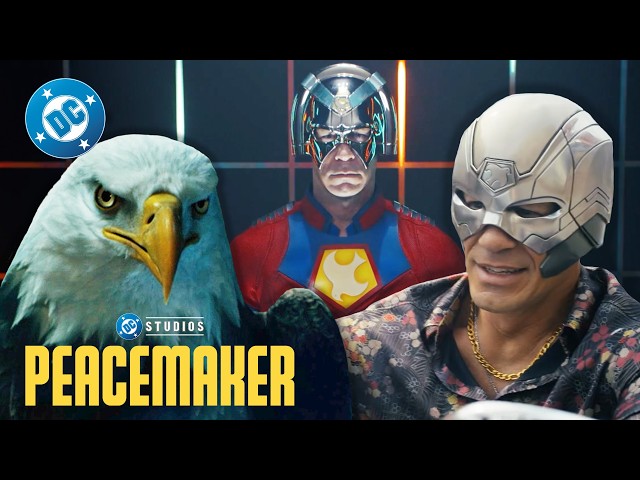

That tension is what makes Peacemaker so good for writers to study.
It understands that comedy and pain are not opposites. They are often sitting in the same room, eating the same stale popcorn, pretending not to know each other.
One of the biggest literary devices at work in Peacemaker is tonal juxtaposition. The show slams absurd comedy directly against trauma. Chris talks about his brother's death, his abusive father, and his violent conditioning, while someone else is rambling about popcorn, body image, or whether his butt is big enough. The collision should destroy the scene. Instead, it makes it sharper.
Why?
Because real people often avoid pain with nonsense.
That is one of the most useful lessons writers can take from the show. Characters do not always deliver trauma in clean, poetic speeches. They deflect. They make jokes. They say something stupid at the exact moment they are about to say something true. They sabotage intimacy because honesty feels more dangerous than violence.
Peacemaker also uses bathos, the sudden drop from serious emotion into ridiculous comedy. Chris can be standing on the edge of real confession, then the scene undercuts him with a filthy joke, a dumb misunderstanding, or a brutally awkward social mistake. Bathos is dangerous because it can make emotional scenes feel cheap if used badly. But here it works because the emotion is still real underneath the joke.
The show laughs at Chris's behavior, not at the fact that he is damaged.
That distinction matters.
A weaker version of this character would just be an idiot with weapons. Peacemaker makes him an idiot with weapons who knows, somewhere deep down, that he is broken. He is not self-aware enough to fix himself easily, but he is self-aware enough to hurt. That is where the pathos comes from.
Another major device is contradiction. Chris is a walking contradiction. He wants peace through murder. He wants connection, but drives people away. He wants to be seen as strong, but he is emotionally desperate. He wants to escape his father's violence, yet keeps repeating the lessons his father burned into him.
Contradiction is one of the fastest ways to make a character feel alive.
Perfectly consistent characters are often boring. Real people are messy. They believe one thing and do another. They want forgiveness but resist accountability. They want love but act unlovable. Chris Smith is built almost entirely out of contradictions, which is why he can be funny, pathetic, dangerous, and lovable in the same scene.
The compilation also shows how Peacemaker uses running jokes as character development. The "bird blindness" exchange is stupid in the best possible way. Someone looks at Eagly and calls him a parrot. Then the bit keeps escalating until "bird blindness" becomes this absurd personal weakness. On the surface, it is just a dumb joke. But inside the larger show, even the dumb jokes help build a world where everyone is damaged in weirdly specific ways.
That is another craft lesson. A running joke should not only repeat. It should reveal.
The best repeated jokes become part of the character ecosystem. They tell us how people see themselves, how they defend themselves, how they bond, and how they avoid saying what they really mean.
Peacemaker also uses repetition as emotional pressure. Chris keeps returning to the same wounds: his brother, his father, Rick Flag Jr., the people he has killed, the fear that everyone around him dies because of him. He does not process trauma in one clean breakthrough. He circles it. He crashes into it again and again. He asks the same emotional questions because the answer never seems to stay fixed long enough to save him.
That is very true to trauma.
A character does not simply say, "I understand my wound now," and become healed. The wound repeats itself. It changes shape. It shows up in jokes, arguments, bad decisions, violence, sex, loyalty, panic, and desperate little questions like, "Did it mean anything?"
That repeated question is one of the most human moments in the transcript. Chris is not asking for a tactical answer. He is asking whether he mattered. Whether he was used. Whether he was disposable. Whether one moment of intimacy meant anything to the other person, or whether he once again misunderstood the only kind of closeness he knows how to reach for.
That is not superhero storytelling. That is wounded-human storytelling wearing a superhero costume.
The show also uses absurdity as emotional camouflage. The multiverse material, the alternate self, the weird animal confusion, the dimensional portal, the comic-book insanity, all of it could be pure spectacle. But Peacemaker keeps dragging it back to Chris's central wound: no matter what world he enters, he brings himself with him.
That is why the line "It's me" lands.
The horror is not that the wrong universe exists. The horror is that Chris cannot outrun Chris.
For writers, that is gold. External plot should force the internal wound into the open. The portal is not just a portal. The alternate world is not just a gimmick. The action is not just action. It all becomes a machine designed to make Chris confront the thing he does not want to know about himself.
Great genre writing does this all the time.
The monster is the grief.
The conspiracy is the guilt.
The alien world is the family trauma.
The superhero mission is the question: "Can a man built by violence become anything else?"
Peacemaker also gets enormous mileage from contrast in dialogue. Characters speak with profanity, stupidity, panic, affection, cruelty, and honesty, often all in the same exchange. The dialogue feels loose and chaotic, but it is doing precise emotional work. Friends insult each other constantly, then suddenly say something painfully sincere. A character can call Chris big and stupid, then tell him he feels loved around him.
That is why the emotional speeches do not feel fake.
They are not polished. They are messy. They sound like people who are bad at feelings trying to do the impossible anyway.
Writers should pay attention to that. Emotional dialogue does not need to sound elegant. It needs to sound earned. Sometimes the most moving line is not the most poetic line. Sometimes it is the line that sounds like a person barely managing to say the truth before embarrassment kills them.
One of the strongest craft moves in Peacemaker is that it does not separate the team dynamic from the theme. The team is not just there to help Chris win fights. They are there to challenge the story he believes about himself.
Chris thinks he is cursed. He thinks everyone around him dies because that is what he does. He destroys things. He kills people. He ruins lives. His friends push back, not by pretending he is innocent, but by making a distinction he cannot make himself.
When he listens to the wrong people, he becomes a weapon.
When he listens to himself, he can become something else.
That is a clean thematic engine.
Peacemaker is not about a bad man magically becoming good because the plot says so. It is about a man learning that obedience is not morality. Following orders does not absolve him. Being damaged does not absolve him either. But neither does guilt have to be the whole story.
The show is also scary in a strange way.
Not jump-scare scary. Not horror scary.
It is scary because it shows how easily a person can be programmed by family, country, ideology, masculinity, authority, and shame. Chris did not become Peacemaker in a vacuum. He was built. His father built part of him. The culture around him built part of him. Government handlers used the rest. Everybody wanted the weapon. Nobody cared much about the person inside it.
That is the real nightmare under the jokes.
A human being can be turned into a tool and then blamed for having sharp edges.
For thriller, horror, and science fiction writers, this is one of the biggest lessons from Peacemaker: the most interesting weapon is the one that starts asking who aimed it.
The compilation also shows how vulnerability can be more suspenseful than violence. Yes, there are fights, guns, portals, monsters, and superhero chaos. But some of the most tense moments come when Chris asks an emotional question and waits for the answer. That is suspense. Not physical suspense, but emotional suspense.
Will she lie?
Will he collapse?
Will the team reach him?
Will he believe them?
Will he choose himself, or the programming?
That kind of suspense keeps a story alive between action scenes. It gives the explosions something to mean.
Another device at work is irony. Peacemaker's entire identity is ironic. He is a peace-loving killer. A patriot who has been abused by the ugliest version of patriotism. A superhero who behaves like a drunken liability. A man who wants to be loved but has been trained to perform toughness so aggressively that love can barely get near him.
The show keeps mining that irony, but it also deepens it. The joke does not stay flat. Over time, the absurd slogan becomes a moral wound. "I cherish peace no matter how many people I need to kill to get it" starts as a joke. But underneath it is the logic of every violent institution that claims murder is just order with better branding.
That is why Peacemaker works as satire too.
It mocks macho hero fantasies, government violence, superhero cleanup squads, patriotic symbolism, and the absurd moral accounting that turns killers into assets as long as they are useful. But the satire never becomes bloodless because Chris is not just a symbol. He is a person.
That is the final lesson writers should take from Peacemaker.
You can write the dumbest possible joke if the emotional spine is strong enough.
You can write a man with a pet eagle, a chrome helmet, a dirty mouth, daddy issues, multiverse problems, and a body count, and still make the audience care deeply about whether he gets one honest answer from a woman on a boat.
But the pain has to be real.
The character has to want something simple under all the chaos.
Chris Smith wants peace, yes.
But more than that, he wants to amount to more than the worst thing he has ever done.
That is why Peacemaker is funny.
That is why it hurts.
And that is why writers should study it.