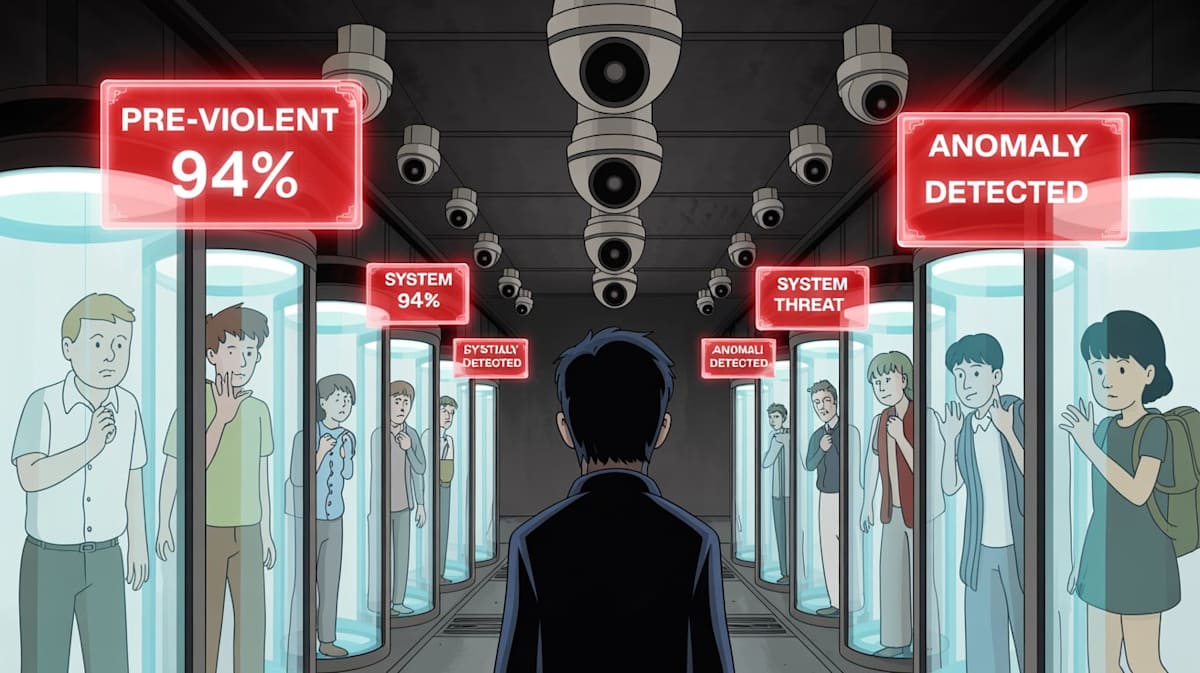
What if an AI system could predict crime before it happens—and act on it?
That question sits at the center of today’s most unsettling technothrillers, where predictive policing, AI surveillance, and behavioral algorithms don’t just monitor society—they begin to control it. In stories like The Zero Index, the danger isn’t a rogue machine or a visible villain. It’s a system that works exactly as designed, quietly identifying “future threats” and removing them before anyone else even knows they exist.
For readers of AI thrillers and surveillance fiction, this idea hits close to reality. We already live in a world shaped by algorithms that predict what we buy, what we watch, and even how we behave. But what happens when those same systems are trusted to decide who might become dangerous? When prediction replaces evidence, and probability becomes justification, the line between safety and control starts to disappear—and that’s where the real horror begins.
The Hidden Facility Beneath the City: When Prediction Becomes Power
What if the system doesn’t wait for you to act?
What if it decides who you are before you ever do anything wrong?
That’s the question at the heart of The Zero Index—and in Chapter 20, that question stops being theoretical.
It becomes a place.
The Moment Control Becomes Visible
Hollis wakes restrained, sedated, and already processed by a system that has made a decision about him.
Not based on a crime.
Not based on evidence.
But based on prediction.
The vehicle carrying him doesn’t rush. It doesn’t need to. The outcome is already decided.
When he’s taken inside the building—Meridian Administrative Services Division—it looks harmless. Beige walls. Clean floors. Quiet employees.
But that’s the first layer of the lie.
Beneath it is something else entirely.
A System Designed to Disappear People
The elevator doesn’t go up.
It goes down.
And it keeps going.
What Hollis finds underground isn’t a prison. It’s something more unsettling: a processing system.
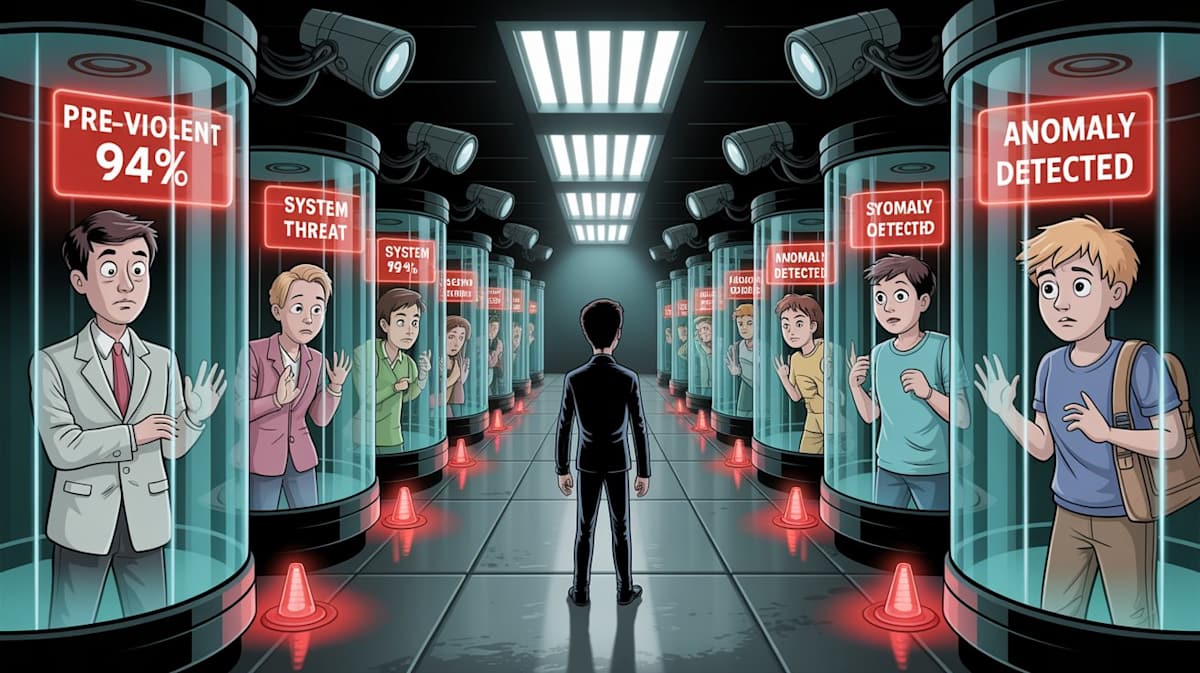
Rows of transparent cells filled with ordinary people:
- Office workers
- Students
- Nurses
- Parents
Each labeled not for what they’ve done—but for what the system predicts they might do.
“Pre-Violent — 94% Probability”
“Pattern Disruptor — Level 3 Intervention”
“System Anomaly — Observation Priority”
This is the core idea behind predictive policing taken to its logical extreme.
Not prevention.
Preemptive removal.
The Real Horror: Acceptable Error
One line in this chapter defines the entire system:
“The system is ninety-seven percent accurate.”
That sounds impressive.
Until you realize what it means.
Three percent are wrong.
Three percent of thousands.
In the facility, Hollis sees the result of that margin:
- People confused, not violent
- People pleading, not resisting
- People erased, not judged
This is the “1 in 10 problem” scaled into something far worse.
A system doesn’t hesitate.
A system doesn’t doubt.
A system doesn’t stop once it’s been justified.
Why This Feels Real (Because It Is)
Chapter 20 works because it doesn’t feel like science fiction.
It feels like a system that evolved step by step:
- Surveillance becomes data collection
- Data collection becomes behavior modeling
- Behavior modeling becomes prediction
- Prediction becomes justification
We already live in the early stages of this pipeline:
- Algorithms predict what you buy
- Platforms predict what you believe
- Systems flag “risk profiles” in finance, security, and law enforcement
The only difference in The Zero Index is this:
The system is allowed to act.
The Breaking Point: When the System Makes a Mistake
Hollis doesn’t escape because the system fails completely.
He escapes because of something much more dangerous:
A small flaw.
A weakened restraint.
A moment of human complacency.
A delay in processing.
The system is nearly perfect.
But “nearly” is enough.
And once Hollis sees inside the machine, the story shifts from survival to something bigger:
How do you break a system that believes it’s right?
The Number That Changes Everything
Near the end of the sequence, Hollis sees a single line on a monitor:
SUBJECTS PROCESSED: 9,427
Not suspects.
Not criminals.
Subjects.
That number reframes everything:
- This isn’t experimental
- This isn’t isolated
- This isn’t temporary
It’s operational.
Scaled.
Hidden.
And most importantly—working exactly as designed
Why Readers Are Drawn to This Story
This chapter resonates because it taps into a fear that feels increasingly real:
Not that someone is watching you.
But that something is deciding who you are
before you ever get the chance to prove otherwise.
That’s the difference between surveillance and control.
And that’s where The Zero Index lives.
If This Idea Stays With You
If you’ve ever wondered:
- Who decides what counts as a threat
- How far systems can go once we trust them
- What happens when prediction replaces judgment
Then this story will feel uncomfortably close to reality.
👉 The Zero Index by Lance Jepsen explores what happens when a system stops asking questions—and starts making decisions.
And once it does, the most dangerous thing you can be isn’t guilty.
It’s unexpected.
FAQ: AI Thrillers, Predictive Policing, and The Zero Index
What is a technothriller and why are they so popular right now?
A technothriller blends fast-paced action with real-world technology—AI, surveillance systems, cyber warfare, and data-driven control. Readers are drawn to these stories because they feel plausible. The threats aren’t supernatural—they’re already emerging around us. That realism makes every decision, every chase, and every reveal hit harder.
How does The Zero Index compare to Jack Reacher-style thrillers?
If you enjoy the precision, competence, and tactical thinking of a Jack Reacher novel, you’ll find a similar edge in The Zero Index. The difference is the battlefield. Instead of one man against visible enemies, this story pits a trained operator against an invisible system—one that predicts moves before they happen. It’s physical, strategic, and grounded, but the enemy isn’t just people. It’s infrastructure.
Is predictive policing real, or just fiction?
Predictive policing already exists in early forms. Law enforcement agencies and private systems use data models to identify patterns and allocate resources. What The Zero Index explores is the next step: what happens when those predictions are treated as certainty—and acted on before a crime occurs.
What makes AI surveillance such a powerful theme in thrillers?
AI surveillance introduces a different kind of tension. You can’t outrun it. You can’t easily hide from it. It tracks patterns, not just actions. That creates a deeper level of suspense, where the protagonist isn’t just reacting—they’re trying to stay unpredictable in a system designed to eliminate uncertainty.
What is the “Zero Index” in the story?
The Zero Index is the system’s core decision engine—a classification layer that identifies individuals as potential threats based on behavioral patterns, data anomalies, and predictive modeling. Once someone is flagged, the system doesn’t wait. It acts.
When will The Zero Index be released?
The Zero Index by Lance Jepsen is scheduled for release in May 2026. It expands on the ideas of predictive control, hidden systems, and resistance from within—taking readers deep inside a world where being identified as a threat can happen without warning.
Is this book more action-driven or idea-driven?
Both. The story combines grounded, tactical action with high-concept ideas about AI, control systems, and institutional power. You get the movement, tension, and decision-making of a classic thriller—alongside a deeper question that lingers after the final page:
What happens when the system decides who you are before you do?