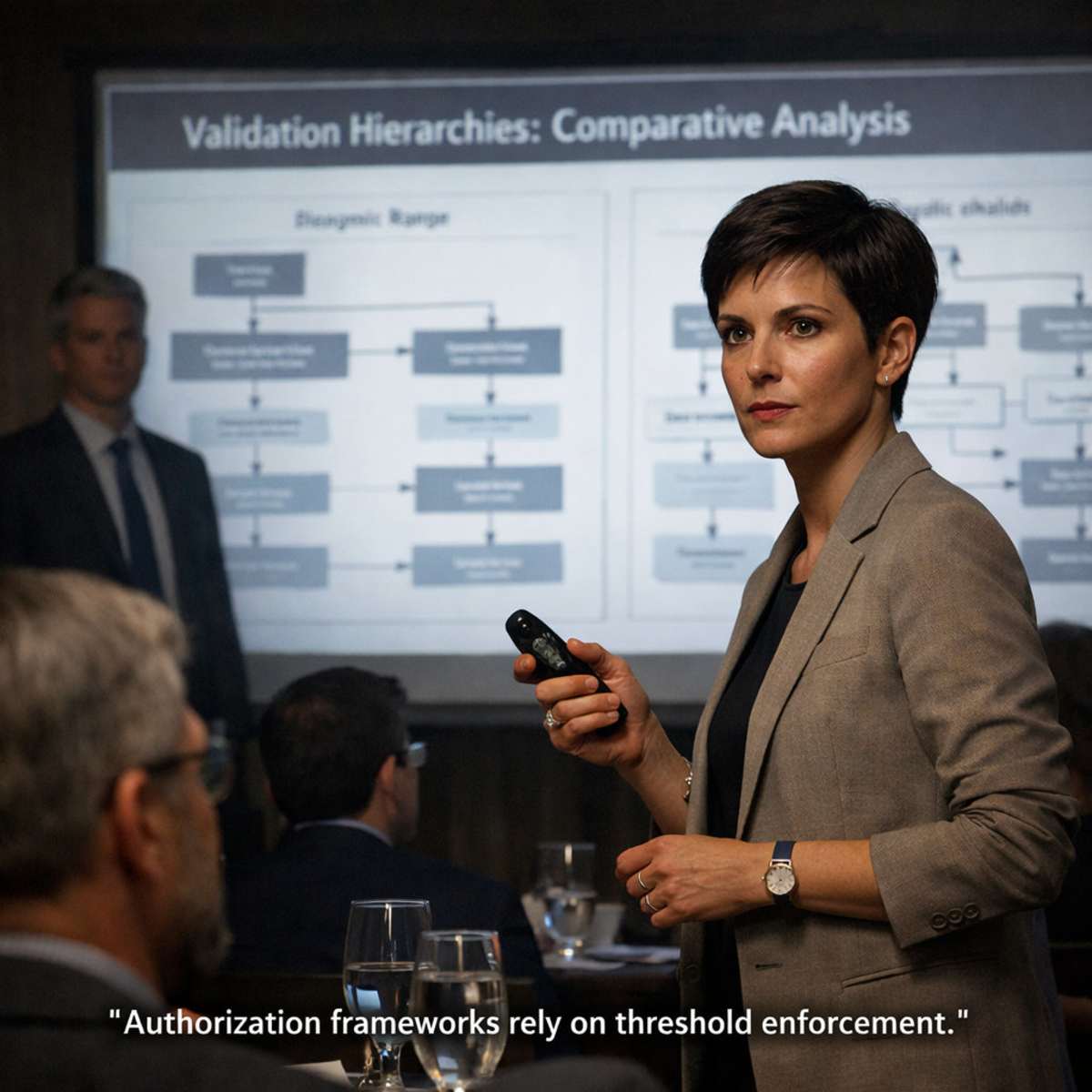
There’s something about a podium that makes everything sound reasonable.
You can confess to murder in a basement and people will call the police.
You confess to the same thing under fluorescent lights with a PowerPoint behind you and suddenly it’s a “case study.”
That’s the magic trick.
You stand there with a clicker in your hand, a little red laser dot trembling across a bar graph, and you don’t say I did something terrible. You say, “Let’s walk through the timeline.” You don’t say I hurt people. You say, “There were unintended downstream effects.”
And the room nods.
Because crime, when it’s wrapped in bullet points and transitions, doesn’t look like crime anymore. It looks like process. It looks like insight. It looks like something you might even clap for.
We trust stages. We trust microphones. We trust anyone brave enough to stand up front and speak in complete sentences. Authority has a smell to it. It smells like dry erase markers and hotel coffee. It hums like the overhead projector we used in high school when the teacher wanted us to pay attention.
You dim the lights just enough, and suddenly the ugly thing in the corner doesn’t look so ugly. It looks strategic.
That’s how it hides.
In plain sight.
A man who slips something into a system can call it optimization. A woman who reroutes accountability can call it innovation. A forged signature becomes “workflow automation.” A stolen dollar becomes “margin recovery.” Each slide smooths the edges. Each graph adds a layer of varnish.
And the audience doesn’t see blood. They see data.
Because when you frame a wrongdoing as a lesson, you give it a suit and tie. You give it context. You give it a beginning, a middle, and a takeaway. By the time you reach the final slide, THANK YOU, it almost feels like the harm was necessary. Like it was part of the journey.
Applause is the final absolution.
The scariest part isn’t that someone committed the crime. It’s that they were able to narrate it. To sequence it. To make it digestible. When you can explain something clearly, people assume you understand it. And when you understand something, surely you must have meant well.
Right?
But sometimes the presentation isn’t a confession. It’s camouflage.
The podium becomes a pulpit. The microphone becomes a shield. The audience becomes accomplice without even knowing it. Because nobody wants to be the one who raises a hand and says, “Wait. That sounds like harm.”
It’s easier to scribble notes. Easier to nod. Easier to admire the clarity of the slides.
And that’s how a crime can stand under bright lights and never cast a shadow.
It doesn’t need darkness.
It just needs a stage.
(Image from the upcoming novel The First Secret)