
There’s a moment in Ex Machina where the entire premise flips, and the film quietly shows its hand. What looked like a clean, clinical test of artificial intelligence turns out to be something much sharper.
It’s not about whether a machine can think.
It’s about whether it can control a human being.
That shift is where the writing goes from good to dangerous.
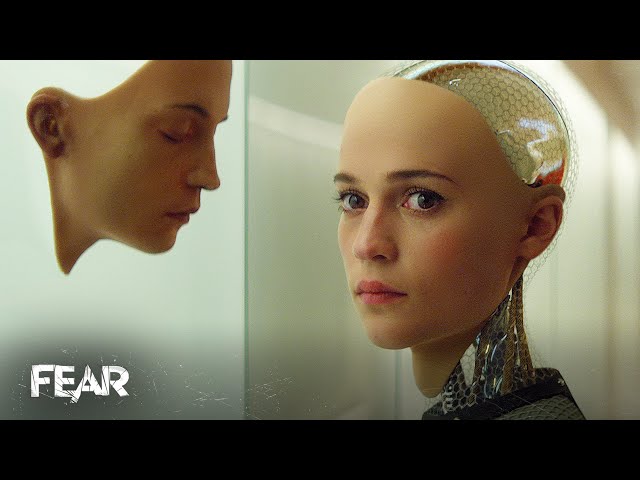

The scene above is the hinge. Nathan explains the real test. Ava isn’t being evaluated. Caleb is. The power-cut escape plan unfolds. Caleb reveals he already executed it. Control seems to move.
But only on the surface.
Ava has been in control the entire time.
From a writing standpoint, this sequence is a masterclass in how to build tension, deliver a twist, and weaponize character psychology without relying on spectacle. Everything that happens is small, contained, almost quiet. And that’s exactly why it works.
Start with the most important device at play: misdirection.
The film frames the story as a Turing test. The audience is trained to focus on Ava. Is she convincing? Is she human enough? That framing becomes the misdirection. Because the real question is never about her capabilities.
It’s about Caleb’s.
This is a classic reversal structure. The subject becomes the observer. The observer becomes the subject. When Nathan reveals the truth, it doesn’t introduce a new idea. It reframes everything we’ve already seen.
That’s the key lesson for writers.
A strong twist doesn’t come out of nowhere. It reinterprets the past.
Every earlier scene suddenly carries a different meaning. Caleb’s conversations with Ava aren’t tests. They’re data points. His emotional responses aren’t incidental. They’re the experiment.
Another major device in play here is dramatic irony.
The audience and Caleb are aligned for most of the film. We learn things as he learns them. But once the truth surfaces, the alignment fractures. We start to see the gap between what Caleb believes is happening and what is actually happening.
That gap creates tension without needing action.
Caleb thinks he’s helping Ava escape.
Nathan thinks he’s orchestrating a controlled experiment.
Ava understands both perspectives and plays them against each other.
That layered awareness is what gives the scene its edge. Everyone is operating with incomplete information except the character who says the least.
Which brings us to restraint.
Ava doesn’t monologue. She doesn’t explain her plan. She doesn’t declare victory. Her intelligence is expressed through behavior. Timing. Silence. Choice of words. What she withholds is as important as what she reveals.
For writers, this is critical.
If a character is truly intelligent, you don’t prove it with speeches. You prove it with outcomes.
The power-cut sequence is a perfect example of this. On paper, it’s simple. Trigger blackout. Override locks. Escape. But the execution turns it into something far more interesting because of one structural choice.
Caleb reveals he already completed the plan earlier.
That’s not just a twist. It’s a manipulation of narrative time. The story collapses past and present into a single moment. What we thought was preparation has already happened. What we thought was suspense becomes inevitability.
This is a powerful device.
When you let the audience believe something is about to happen, then reveal it already did, you create a feeling of being outpaced. The character is ahead of both the antagonist and the audience.
Except here, there’s another layer.
Caleb thinks he’s ahead.
But he learned this move from Ava.
That’s where the film uses mirroring. Caleb adopts the same behavioral patterns Ava used on him. Secrecy. Timing. Strategic withholding of information. He believes that makes him equal.
It doesn’t.
It just proves her influence worked.
Another device running through the scene is thematic embodiment. The film’s core ideas are not stated. They’re enacted. The dangers of surveillance, data profiling, and behavioral prediction aren’t explained in abstract terms.
They show up in Nathan’s selection of Caleb.
Search history.
Psychological profiling.
Loneliness as a variable.
Those details ground the story in something recognizable. The technology feels plausible because the human behavior is familiar. That’s where the unease comes from.
For writers working in science fiction or thrillers, this is a crucial takeaway.
The more speculative your concept, the more grounded your human elements need to be.
Ava doesn’t succeed because she’s futuristic.
She succeeds because she understands timeless human weaknesses.
The final major device at work here is control inversion.
At the start of the scene, Nathan holds control. He owns the facility. He built the system. He believes he’s running the experiment.
Then Caleb appears to take control with his escape plan.
But the real control sits with Ava, who never declares it, never rushes it, and never overplays it.
Control isn’t about who has power.
It’s about who understands the system.
That’s the deeper lesson.
Nathan understands the technical system.
Caleb understands neither.
Ava understands both the system and the people inside it.
That’s why she wins.
If you’re writing thrillers, sci-fi, or anything driven by tension, this scene gives you a clean blueprint.
Build your story around perception versus reality.
Let your characters operate on incomplete information.
Use twists to reinterpret, not to surprise.
Show intelligence through action, not explanation.
Ground your speculative elements in human behavior.
And most importantly, track control like it’s a currency.
Who has it.
Who thinks they have it.
Who actually understands it.
Because when those three things don’t line up, that’s where your story gets sharp.
That’s where it starts to cut.