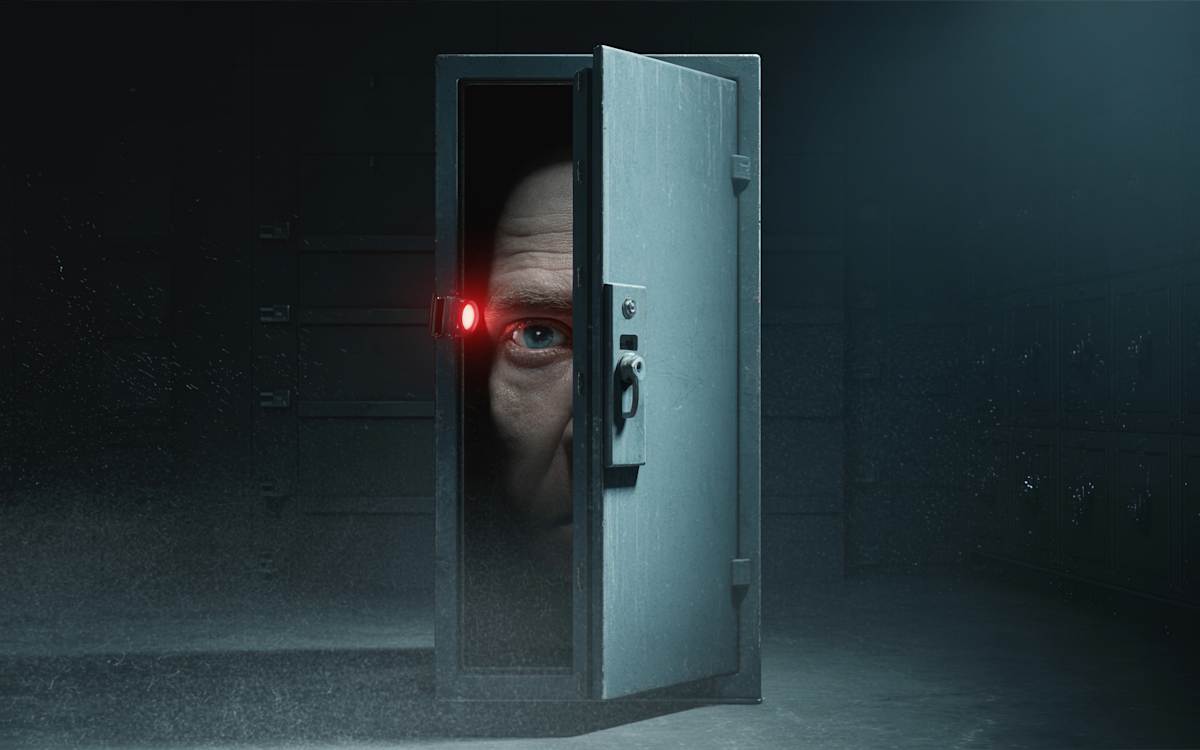
You can always tell when a room is being watched.
Not because you see the camera.
Because the air feels organized.
I was in a hotel room once—one of those beige, carpeted boxes that smells faintly of citrus cleaner and other people’s sleep. There was a smoke detector in the corner. Or maybe it was a smoke detector. White. Round. Innocent as a communion wafer.
But it had a little black eye in the center.
And I remember thinking: That’s not for smoke.
Now, before you roll your eyes and decide I’ve gone full conspiracy uncle at Thanksgiving, let me say this—I don’t believe in monsters under the bed.
I believe in systems.
Monsters are sloppy. Systems are patient.
We’ve built a world that records everything. Your doorbell watches the street. Your phone maps your footsteps. Your car remembers how fast you braked last Tuesday at 4:17 p.m. Your refrigerator probably knows when you stress-eat leftover pie.
We call it convenience.
We call it safety.
We call it smart.
But the thing about smart systems is this: they don’t forget.
And neither do the people who control them.
You ever notice how crime shows changed over the years? It used to be a bloody knife and a footprint in the mud. Now it’s metadata. Wi-Fi pings. Access logs. Timestamp discrepancies down to the millisecond.
The killer doesn’t just leave fingerprints anymore.
He leaves patterns.
And patterns are what scare me.
Because patterns don’t shout. They whisper.
They live in spreadsheets and server rooms and climate-controlled lockers where evidence waits for someone curious enough to notice the one file that doesn’t quite fit.
The truth is, we’ve all agreed to live inside a giant evidence room. Cameras on the corners of buildings. Cameras in elevators. Cameras in parking garages. Cameras staring down like metal vultures over every red light in town.
You tell yourself you don’t care because you’ve done nothing wrong.
That’s the comfortable lie.
The real question isn’t whether you’ve done something wrong.
It’s whether someone, somewhere, could rearrange the story of your life using the fragments you leave behind.
A late-night drive.
A deleted text.
A gap in GPS tracking.
A purchase you don’t remember making.
Put those pieces in the wrong hands and suddenly you’re not the hero of your own story anymore.
You’re a suspect.
That idea—that quiet, creeping shift from safety to surveillance—is what keeps me writing thrillers.
Not the gore.
Not the jump scares.
The slow realization that the walls are listening, and worse… they’re filing.
In my upcoming thriller, The Evidence Locker, Detective Mara Kincaid doesn’t chase shadows in alleyways.
She hunts anomalies.
A phone that’s warm when it shouldn’t be.
A patrol pattern that deviates by exactly three minutes.
A security feed that flickers once—and only once—before a body is discovered.
Because sometimes the most terrifying thing isn’t a killer.
It’s the infrastructure that makes him invisible.
We live in an age where nothing disappears. Not really. It just gets archived.
Indexed.
Stored.
Waiting.
And I can’t help wondering—if someone opened the locker with your name on it… what would be inside?
That’s the question that keeps me up.
And maybe, if you’re honest, it keeps you up too.
If you like your suspense intelligent, unsettling, and just a little too plausible for comfort, you might want to keep an eye on this space.
The locker opens soon.
And it already knows more about you than you think.