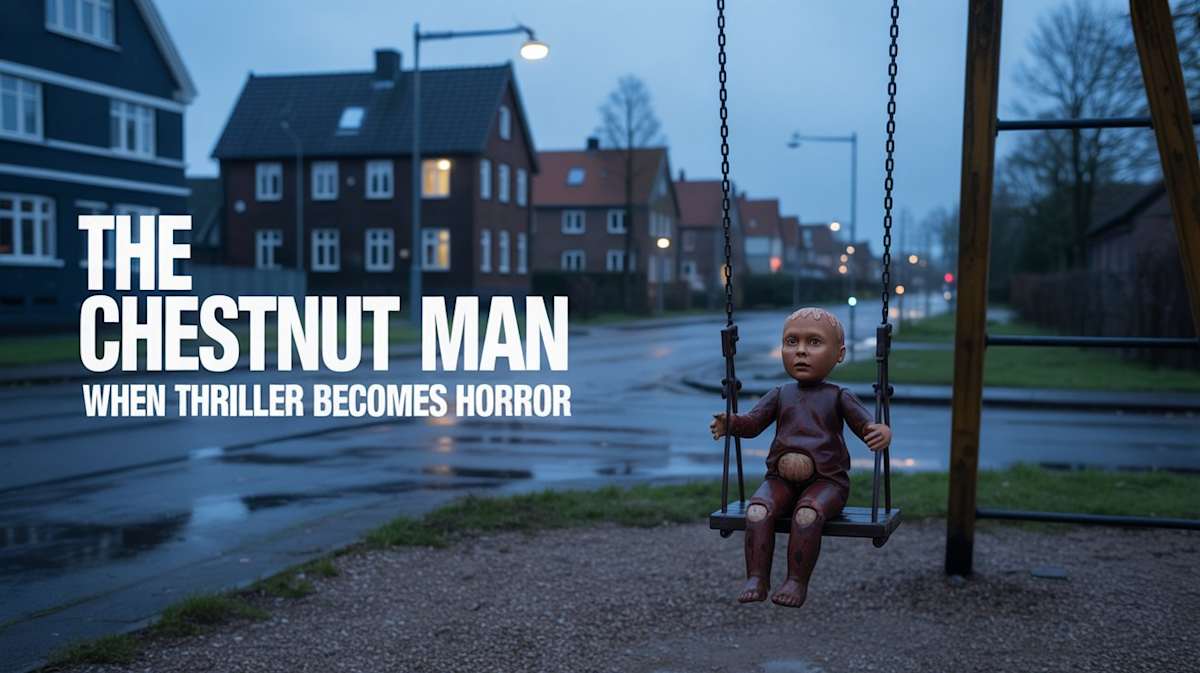
Some thrillers entertain. Some keep you guessing.
And then there are the rare ones that follow you out of the room, linger in the quiet, and make you second-guess the dark corners of your own house.
The Chestnut Man is that kind of story.
I went into it expecting a tight Nordic noir procedural. What I got instead was something that genuinely got under my skin and stayed there longer than I wanted it to. Not jump-scare fear. Not cheap shock. The slow, invasive kind of dread that builds while you’re watching—and then keeps working on you afterward.


A Thriller That Thinks Like Horror
On paper, the series checks all the thriller boxes:
- Two investigators with clashing methods
- A string of connected murders
- A hidden pattern waiting to be uncovered
Detectives Naia Thulin and Mark Hess are pulled into a case where each crime scene features a small chestnut figurine. It’s a simple calling card. Almost innocent at first glance.
That’s the hook.
Because the show understands something most thrillers don’t: horror doesn’t come from what’s loud—it comes from what feels wrong.
The chestnut dolls are wrong in a way that’s hard to articulate. Childlike. Handcrafted. Personal. The kind of object that shouldn’t be anywhere near violence—and yet there it is, quietly linking everything together.
And that contrast is what starts to burrow in.
The Part That Got Under My Skin
What really unsettled me wasn’t just the violence. It was the intent behind it.
There’s a precision to everything in this story. The killer isn’t chaotic. They’re deliberate. Patient. Controlled.
That’s what made it terrifying.
Because as the investigation unfolds, you start to feel like the events aren’t just happening—they’re being constructed. Designed step by step. The clues aren’t just breadcrumbs. They’re placed.
On purpose.
And once that realization clicks, the entire tone shifts. You’re no longer watching a mystery unfold. You’re watching a system play out.
That’s the moment it got under my skin.
It stopped being about “who did this” and became something colder:
This was always going to happen.
That kind of inevitability is where the horror lives. Not in the act itself—but in the sense that it was planned, timed, and executed without hesitation.
The Literary Devices Doing the Heavy Lifting
From a writing standpoint, the series is incredibly controlled. Every piece is doing work.
Symbolism
The chestnut figure is more than a signature—it’s a psychological trigger. It creates continuity, but more importantly, it creates dread. You see it, and you know something is already too far gone.
Misdirection
The show constantly reframes what you think you understand. It lets you settle into a theory, then quietly pulls the floor out from under it.
Parallel Timelines
Past and present bleed together, reinforcing the idea that this story didn’t start with the current investigation. It’s been in motion longer than anyone wants to admit.
Character Contrast
Thulin’s grounded, methodical approach plays against Hess’s more instinctive, volatile edge. That tension keeps scenes sharp—but it also reinforces the idea that no single perspective is enough to understand what’s happening.
Atmosphere as Pressure
The setting does a lot of the work. Quiet neighborhoods. Empty spaces. Muted colors. Everything feels slightly drained of warmth, like the environment itself knows something is wrong.
Why It Works So Well
A lot of thrillers rely on escalation—bigger twists, faster pacing, louder stakes.
The Chestnut Man does the opposite.
It tightens.
It narrows your focus. It builds pressure slowly. It lets you sit with discomfort instead of rushing past it. And because of that, when the revelations come, they don’t feel like plot twists.
They feel like confirmations of something you were already starting to fear.
The Story Continues: Hide and Seek
The next chapter is coming with The Chestnut Man: Hide and Seek, set to continue the story with a new case and a new psychological game.

If the first season was about patterns and inevitability, this one looks like it’s pushing further into control—into the idea of a killer who doesn’t just act, but orchestrates.
Given how deeply the first season got under my skin, that’s not exactly a comforting thought.
Final Take
The Chestnut Man isn’t just a thriller. It’s a study in controlled dread.
It understands that the most effective fear doesn’t come from chaos. It comes from structure. From intention. From the quiet realization that every piece is exactly where it’s supposed to be.
And once you see that pattern, you don’t really unsee it.
That’s what stayed with me.
That’s what made it terrifying.