There’s a particular kind of evil that doesn’t break windows.
It doesn’t kick in doors or leave muddy footprints across the kitchen tile. It doesn’t breathe down your neck in a dark hallway.
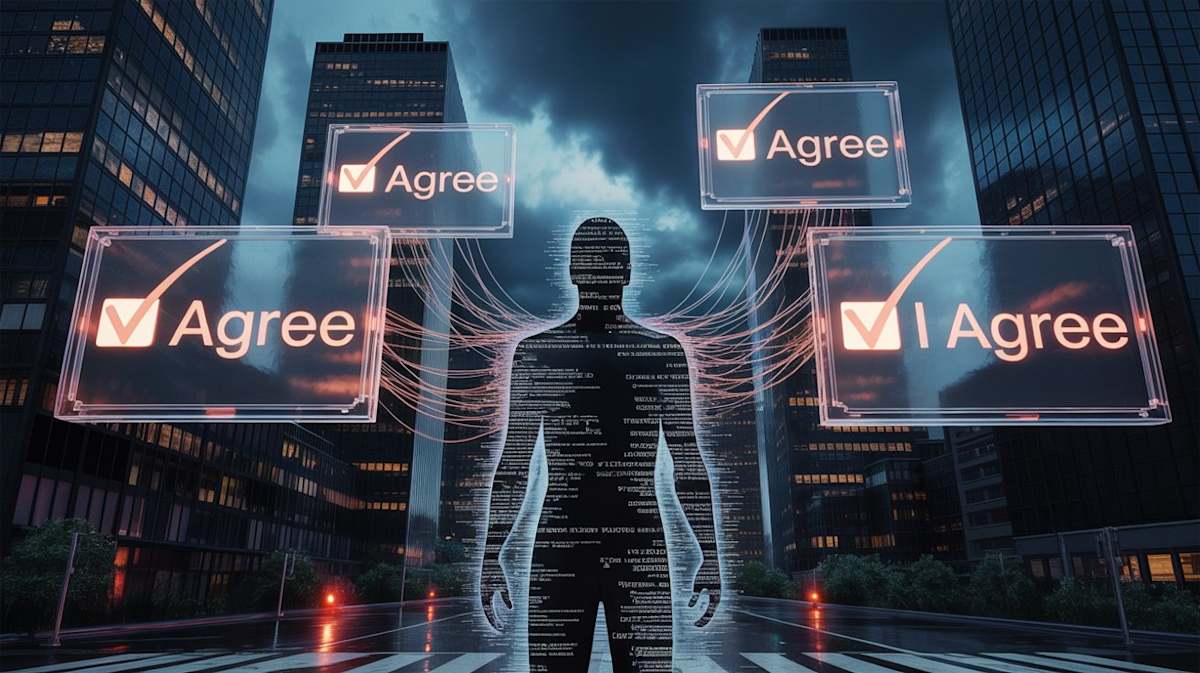
It asks you to click a box.
I agree.
That’s all.
No blood oath. No whispered incantation. Just a quiet, polite square on a glowing screen. You’re in a hurry. You’re ordering groceries. Downloading an app. Signing up for a newsletter. Updating your phone. The world keeps moving, and you don’t have time to read twelve pages of legal lullabies written in a font so small it could hide between the fibers of a dollar bill.
Each authorization alone seems reasonable.
Yes, you may access my location.
Yes, you may share anonymized data.
Yes, you may retain metadata for “service improvement.”
Yes, yes, yes.
Individually, they’re harmless. Sensible, even. Like handing a neighbor a spare key because you trust him to water the plants while you’re gone.
But nobody tells you that five neighbors, each holding a different key, can open the house all at once.
That’s where the vulnerability lives.
Not in the single signature.
Not in the single click.
But in the intersection.
Imagine a killer who understands that better than anyone alive.
He doesn’t stalk victims in the traditional sense. He doesn’t chase them through forests or wait in parked vans. He studies consent pathways. He reads the small print you didn’t. He maps the invisible highways between companies, platforms, agencies. He knows how your location data intersects with your health metrics, how your purchasing history brushes against your biometric identifiers, how your “anonymized” profile isn’t anonymous at all once it touches three other databases that whisper your name.
He doesn’t break the law.
He assembles it.
Each authorization was freely given. Each box was checked by the victim’s own hand. Every step compliant. Every transfer logged. Every data packet perfectly legal.
Until the moment they converge.
That’s when the trap closes—not with a scream, but with a confirmation email.
We like to think monsters come from outside the system. We imagine them as aberrations, glitches in the code of civilization. But what if the monster is the code? What if the killer is simply the first person ruthless enough to see how the permissions overlap? How the architecture hums when pushed just slightly beyond its intended limits?
The most terrifying words in the modern world might not be Help me.
They might be:
By proceeding, you acknowledge and agree…
That’s the heart of my upcoming novel, The Consent File.
It isn’t about a madman hiding in shadows. It’s about a world that has signed its own shadow into existence. It’s about what happens when compliance becomes camouflage. When “I agree” becomes a weapon. When the paperwork is cleaner than the crime scene.
And when someone finally realizes that the real danger was never in the small print—
It was in how all the small prints fit together.
Because sometimes evil doesn’t force you to open the door.
It waits for you to authorize it.