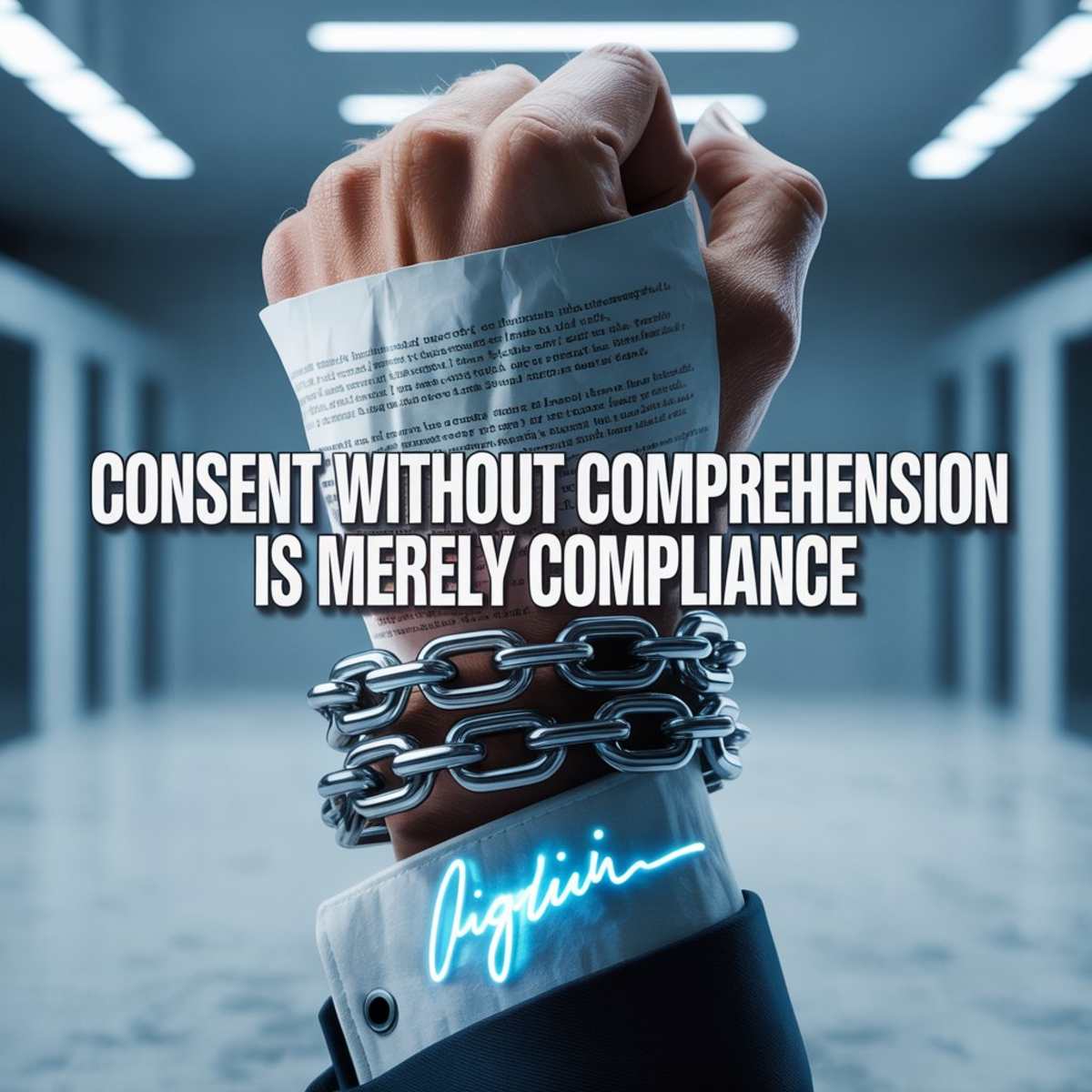
There’s a moment—small, forgettable, almost polite—when the screen glows and asks for your consent.
You don’t read it.
You scroll.
You click.
You move on.
We all do.
It’s become the quiet ritual of modern life, like locking the door behind you or checking the stove before bed. Terms and Conditions. Updated Privacy Policy. New User Agreement. Forty-seven pages of language written in a dialect that looks like English but feels like a spell. Paragraphs stacked like bricks. Definitions nested inside definitions. Rights granted. Rights waived. Arbitration clauses crouched like trapdoors.
We don’t read it because we trust the system.
Or maybe we don’t trust it at all—but we’ve learned something more dangerous than trust.
We’ve learned compliance.
There’s a difference between consent and comprehension. One is an act of will. The other is an act of understanding. And somewhere along the way, we started confusing the two.
Consent without comprehension is merely compliance.
It’s the nod you give because the line behind you is long.
It’s the signature you scribble because the nurse is already turning away.
It’s the “I Agree” button that stands between you and the thing you want.
In my upcoming novel, The Consent File, that idea becomes more than a metaphor. It becomes a crime scene.
Because what happens when the fine print isn’t just about cookies and data storage?
What happens when it’s about you?
What happens when the language is airtight, legally pristine, digitally verified—and still deeply, morally wrong?
The world of The Consent File isn’t science fiction in the way flying cars are science fiction. It’s tomorrow morning. It’s the quiet architecture of compliance systems that hum beneath our lives. It’s the idea that if you signed it—if you clicked it—if you authenticated it with your thumbprint and a six-digit code—then you agreed.
Even if you didn’t understand.
Even if you couldn’t.
That’s the horror that keeps me up at night. Not monsters under the bed. Not ghosts in the hallway.
But language.
Language that looks harmless.
Language that buries intent under precision.
Language that transforms “Do you understand?” into “Did you check the box?”
We think of consent as something intimate, human, sacred even. But in a world of digital signatures and biometric authentication, consent has been industrialized. Processed. Standardized. Optimized for efficiency.
And efficiency doesn’t ask if you understand.
It asks if you complied.
The Consent File begins with a murder, but the real crime runs deeper. It’s about the moment we handed over comprehension in exchange for convenience. The moment we decided that reading was optional, because surely someone else had read it for us. The moment we stopped asking what we were agreeing to—and started assuming it didn’t matter.
But it does.
It always does.
Because someday, somewhere, the fine print will matter in a way that can’t be undone with a password reset or a customer service ticket.
And when that day comes, the question won’t be whether you consented.
The question will be whether you ever understood.
And that difference—that thin, almost invisible line between comprehension and compliance—is where the story lives.
That’s where the horror begins.