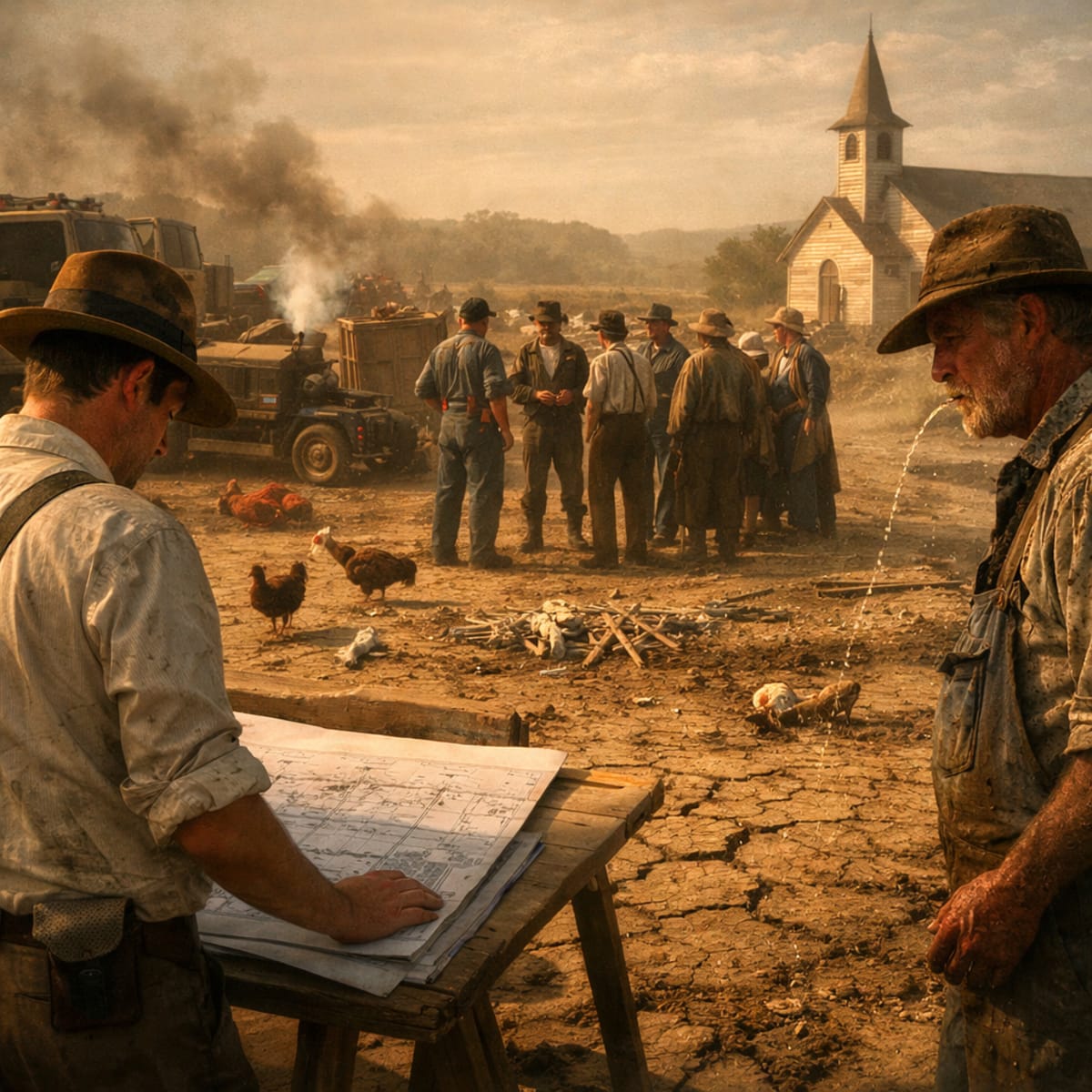
In 1933, the drought did not arrive all at once.
It crept in.
First the river thinned. Then it slowed. Then it began to smell. The crops did not fail dramatically. They simply stopped trying. Corn stalks stiffened into brittle silhouettes. Chickens scratched at earth that no longer remembered what it meant to be soft. Windows stayed shut because dust found its way inside even when doors did not open.
By midsummer, Blackridge had grown quiet in the way sick rooms grow quiet. Not peaceful. Not calm. Just waiting.
When the government trucks came, no one celebrated.
Men stepped down in clean overalls with rolled blueprints and confident voices. They spoke of depth tables, limestone shelves, aquifer pressure. They spoke of relief as if it were something that could be measured with a ruler and signed into existence.
The town watched.
Because there are places in every town that people do not talk about. Not because they do not know, but because they do.
The engineer assigned to the project believed in order. In timetables. In extraction rates. He stood in the shadow of the church and unrolled his plans while locals stood behind him, not looking at the paper but at the earth beyond it, the east bank where the soil went strange.
No one explained what that meant.
They began the excavation at dawn.
The first thirty feet were nothing but stubborn dirt and fractured rock. The men sweated and cursed and bled into the dust. At forty feet, the air changed. Not colder exactly. Just wrong. Sound dulled. Heat felt distant. One of the laborers said he felt a faint vibration under his boots, like something turning over in sleep.
He did not return to work the next day.
His bed was made. His boots were by the door.
They kept digging.
Because progress does not pause for discomfort. Because the federal ledger does not include a column for superstition. Because men with authority do not admit that the ground might be aware of them.
Until the shovel broke through.
What waited beneath Blackridge was not limestone.
It was a chamber fused like melted glass, walls pressed with handprints too deep and too deliberate to belong to erosion. In the center, a circle of black water that did not reflect light. It swallowed it.
And the earth, for the first time since the drought began, felt satisfied.
The rain came soon after.
Steady. Heavy. Cleansing.
The river swelled. The crops revived. The town recovered.
Three men did not.
No one wrote their names on the church board. No one asked questions in public. The pit was filled. Concrete was poured. Equipment was packed away.
Reports were filed.
Blackridge survived.
But survival is not the same thing as innocence.
The Well That Watches ( https://books.plot-studios.com/the-well-that-watches ) is the origin beneath The Harvest Town. It is the first documented compromise. The first quiet decision to trade explanation for relief. In this universe, towns do not collapse because of monsters. They endure because they learn to live beside them. Institutions form. Records are adjusted. Memory becomes selective. Prosperity grows over what is buried.
Every story in this world begins with something small. A signature. A silence. A hole in the ground.
And beneath Blackridge, something remains.
Waiting.
The ground does not forget.
It waits.