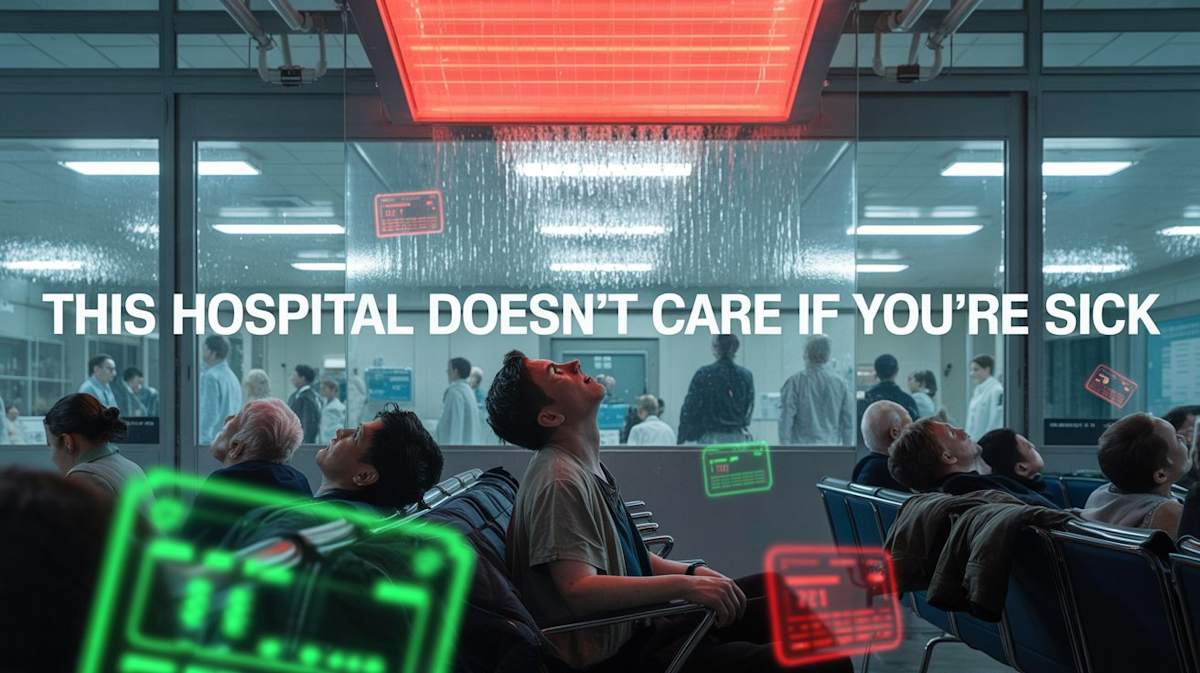
You walk in expecting help.
Flu. Injury. Something wrong you can’t quite explain. It doesn’t matter. You came because something in your body broke, and somewhere deep inside you still believe that means something.
The doors open. Cold air hits your face.
Then the system scans you.
Not your symptoms. Not your pain.
You.
In this world, the first question isn’t what’s wrong with you. It’s what you’re worth.
I’ve been building a setting called the Tier 8 Public Health Node, a place where medicine has been stripped down to its most efficient form. No guesswork. No delays. No wasted resources.
At least, that’s how it’s sold.
The moment you enter, you’re sorted. Not by severity, but by score. A number calculated long before you arrived. A number that decides where you stand, how long you wait, and whether you receive treatment at all.
The space makes sure you understand that immediately.
Transparent partitions divide the room into sections. You can see everything. The higher tiers are quieter, cleaner, spaced out. The lower tiers are packed tight. Heat builds. Air gets heavy. People sit shoulder to shoulder, trying not to look at each other for too long.
Because everyone knows what the numbers mean.
Above you, displays flicker constantly. Green if you’re moving forward. Red if you’re not. Your score. Your wait time. Your authorization status. It updates in real time, like a scoreboard you never agreed to play in.
And the worst part?
Most people don’t question it.
Because most of the time, the system works.
That’s how it wins.
When something is right often enough, you stop asking how it decides. You stop pushing back. You accept the outcome because it feels earned, even when you don’t fully understand it.
Efficiency becomes trust.
Trust becomes silence.
Until the moment it turns on you.
Not in some dramatic, obvious way. Not alarms and chaos and screaming.
Just a small change.
A number shifts.
A color flips from green to red.
The lighting above you feels colder. The air feels tighter. People around you move, just slightly, creating space that wasn’t there a second ago.
And suddenly, you understand something no one explains.
The system didn’t fail.
It made a decision.
About you.
That moment is where this story lives. Not in the technology, not in the machinery, not even in the control.
But in the realization.
That everything around you has been quietly measuring, sorting, and deciding your place long before you ever needed help.
That the system doesn’t hate you.
It just doesn’t need you.
That’s the world of Ledgerfall.
Not a future where control is forced on people.
A future where it’s accepted.
Because it works.
Right up until it doesn’t.