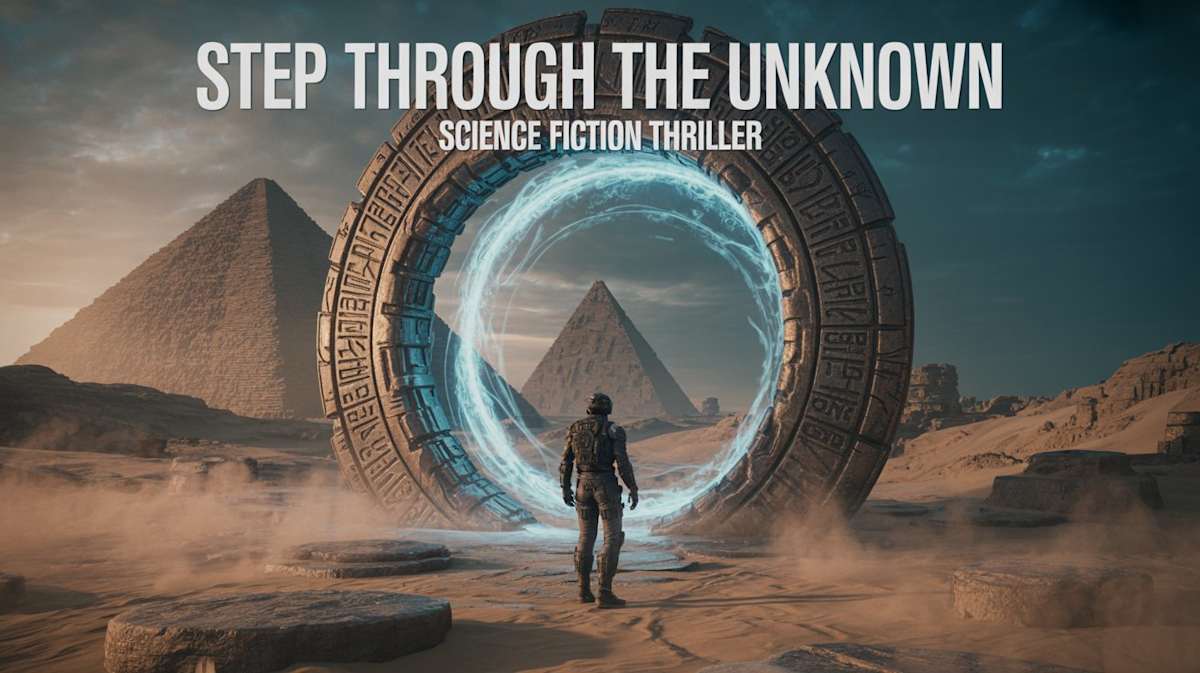
There are certain stories that don’t just entertain you. They calibrate you. They set a tone in your head for what storytelling should feel like. For me, Stargate did that early and never really let go.
Before we break down why Stargate works so well, here’s the film that brings a lot of that DNA into one place.
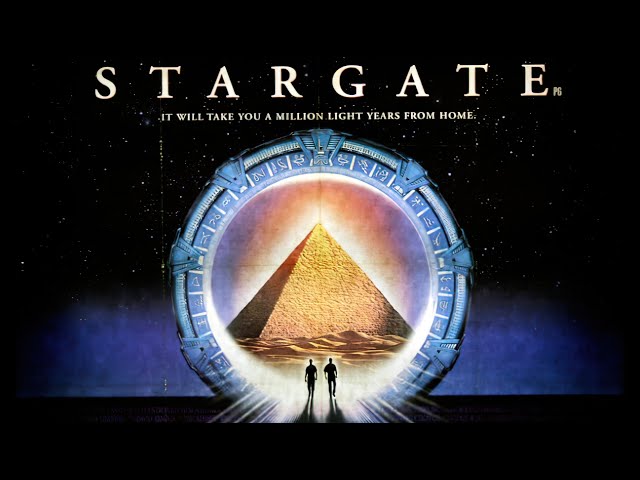

It wasn’t just the premise, although the premise is one of the cleanest, most powerful ideas in science fiction: a ring, a sequence, a destination, and suddenly you’re somewhere else. No long exposition. No overthinking. You step through and the story begins.
That idea stuck with me. It shaped how I think about pacing, about entry points, about how quickly you can move a reader from normal into unknown.
And yeah, it went deeper than that. I named my second daughter after Teyla Emmagan. That’s not casual fandom. That’s a story embedding itself into your life.
The Core Magic of Stargate
At its core, Stargate is doing something deceptively simple: it removes friction from exploration.
Most science fiction builds layers between the character and the unknown. Ships. Travel time. Systems. Procedures. Stargate deletes almost all of that.
Dial. Step. Go.
That immediacy creates momentum. It’s a storytelling accelerant.
As a writer, that’s the first lesson: If you can remove the distance between your character and the story’s central mystery, you should.
The Balance Between Myth and Machinery
What makes Stargate stick isn’t just the tech. It’s the fusion of ancient mythology with hard sci-fi logic.
You’ve got alien systems that feel engineered, layered over symbols, gods, hieroglyphs, and human history. The story hits both sides of the brain at once.
Rational and primal.
That combination shows up everywhere in the franchise, from Stargate SG-1 to Stargate Atlantis. It’s not just “cool tech.” It’s “what if our past is connected to something much bigger?”
As a writer, this is gold:
When you blend the known (history, myth, culture) with the unknown (advanced systems, hidden structures), you create instant depth without heavy exposition.
Characters Who Feel Like They Belong There
Another thing Stargate nails: the people inside the story feel grounded.
They’re not abstract sci-fi archetypes. They react like professionals dealing with something completely outside their training. There’s skepticism, humor, fear, curiosity.
That grounding is what lets the bigger ideas land.
You can build the wildest system in the world, but if your characters don’t behave like real people inside it, the whole thing floats away.
Lesson: The more extraordinary the world, the more ordinary and believable your characters need to be.
The Gateway Structure (And Why It Works So Well)
The Stargate itself isn’t just a prop. It’s a storytelling structure.
Each activation is a promise:
- New environment
- New conflict
- New rules
It’s episodic without feeling disconnected. Contained, but expandable forever.
That’s why the franchise had so much staying power. The format invites infinite variation without breaking its core.
For writers, this is one of the most useful frameworks you can borrow: Build a repeatable entry point into new problems. A system that naturally generates story.
Mystery First, Explanation Later
One of the biggest mistakes in modern sci-fi is over-explaining too early.
Stargate doesn’t do that. It shows you something strange and lets you sit with it. The meaning unfolds over time.
You’re allowed to wonder.
That sense of controlled uncertainty is what keeps people hooked.
Lesson: Curiosity is stronger than clarity in the early stages of a story.
Why It Still Hits
There’s a reason Stargate stuck with me long enough to influence not just my writing, but my life.
It respects the audience. It trusts you to follow. It moves fast without losing coherence. And it builds a world that feels just close enough to ours that you can imagine stepping through that ring yourself.
That feeling matters.
As a writer, you’re always trying to create that moment where someone leans forward instead of back. Where they stop skimming and start imagining.
Stargate does that with a circle, a symbol, and a step into the unknown.
And once that door opens, you don’t really forget it.