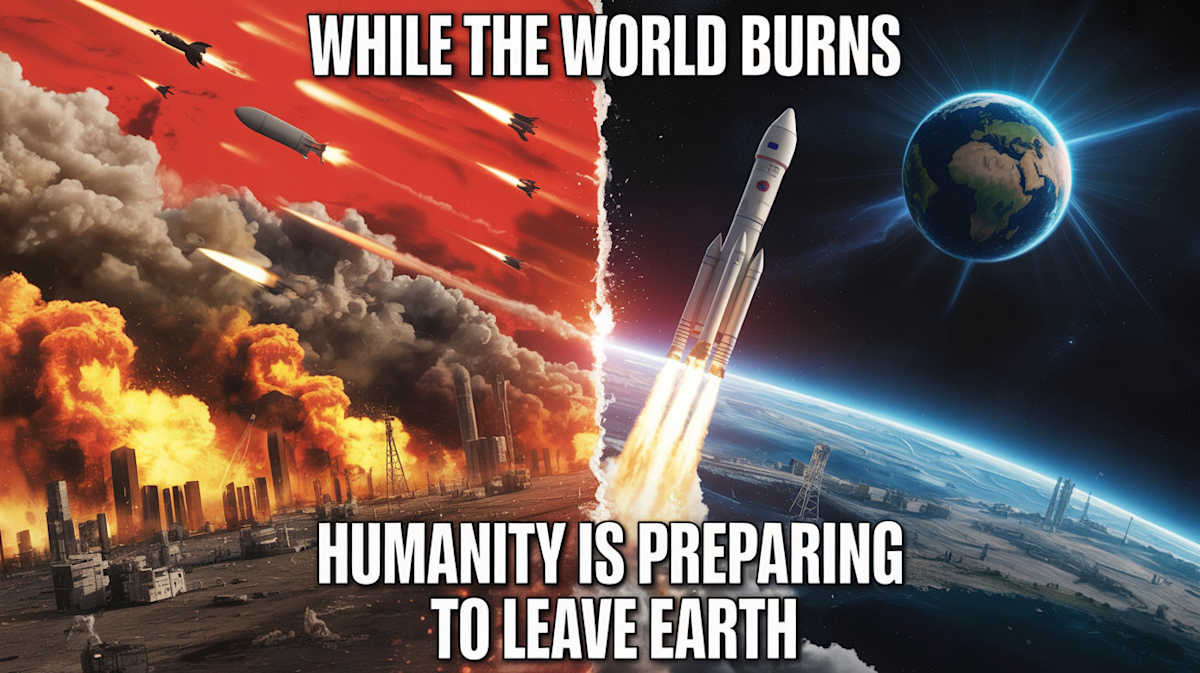
While war dominates the headlines, NASA prepares Artemis II—the first crewed lunar mission around the Moon in over 50 years.
There are moments in history when the future seems to split in two.
Right now feels like one of those moments.
Turn on the news and you’ll see the first timeline: missile strikes, burning cities, leaders promising retaliation, civilians trapped beneath the machinery of war. The footage looks less like modern politics and more like the opening act of a dystopian thriller.
But at the exact same time, something else just happened.
On March 12, NASA completed the Flight Readiness Review for Artemis II—the mission that will send astronauts around the Moon for the first time in more than half a century.
If everything stays on schedule, the massive Space Launch System will roll back to the launch pad around March 19.
The target launch window: April.
Two timelines.
One species.
And they are moving in opposite directions.
Timeline One: The Fire
Human history has a pattern.
We build systems. Nations. Alliances. Technologies.
And then, periodically, we break them.
Sometimes slowly.
Sometimes all at once.
War doesn’t just destroy cities—it consumes the future. It devours budgets, cooperation, and the fragile trust required for long-term projects. Every missile launched today is money that will never build tomorrow.
Space programs are always among the first casualties when the world begins to fracture.
History is full of abandoned visions.
Canceled missions.
Technologies that almost existed.
The path off this planet has never been guaranteed.
Timeline Two: The Escape Route
Meanwhile, the Artemis Program continues quietly assembling humanity’s next step beyond Earth.
Artemis II will send four astronauts on a mission around the Moon to test the systems needed for future lunar landings and deep-space travel.
For the first time since the Apollo era, human beings will leave the protective bubble of low Earth orbit.
Out there, Earth becomes something else.
Not a battlefield.
Not a collection of nations.
Just a small blue sphere floating in black emptiness.
Fragile.
Finite.
Alone.
The Horror Scenario
Here is the darker possibility.
What if we run out of time?
Every generation assumes the future will keep arriving.
But civilizations have vanished before. Entire societies collapsed because they failed to see how close they were to the edge.
History tends to remember the moment right before the fall.
The moment when the lights were still on.
The factories were still running.
The rockets were still being built.
A Species at the Edge
That’s what makes this moment so strange.
Even while the planet argues, burns, and fractures…
A rocket is still being prepared to leave it.
Engineers are tightening bolts.
Astronauts are training.
Launch clocks are counting down.
The machinery of exploration continues with the quiet confidence of a species that believes tomorrow will still exist.
But what if the future we’re preparing for arrives too late?
The View From the Moon
When the Artemis II crew reaches the far side of the Moon, they’ll look back and see Earth hanging in darkness.
No borders.
No politics.
No wars visible from that distance.
Just a thin blue world surrounded by infinite black.
From that vantage point, humanity’s greatest question might finally become obvious.
Not whether we can reach the stars.
But whether we’ll survive long enough to deserve them.
If you enjoy stories about hidden systems, fragile civilizations, and the thin line between survival and collapse, those themes sit at the heart of my thrillers and science-fiction worlds as well.
Because sometimes the most frightening question isn’t whether humanity can reach the stars.
It’s whether we’ll get there before we destroy the only world we have. 🚀