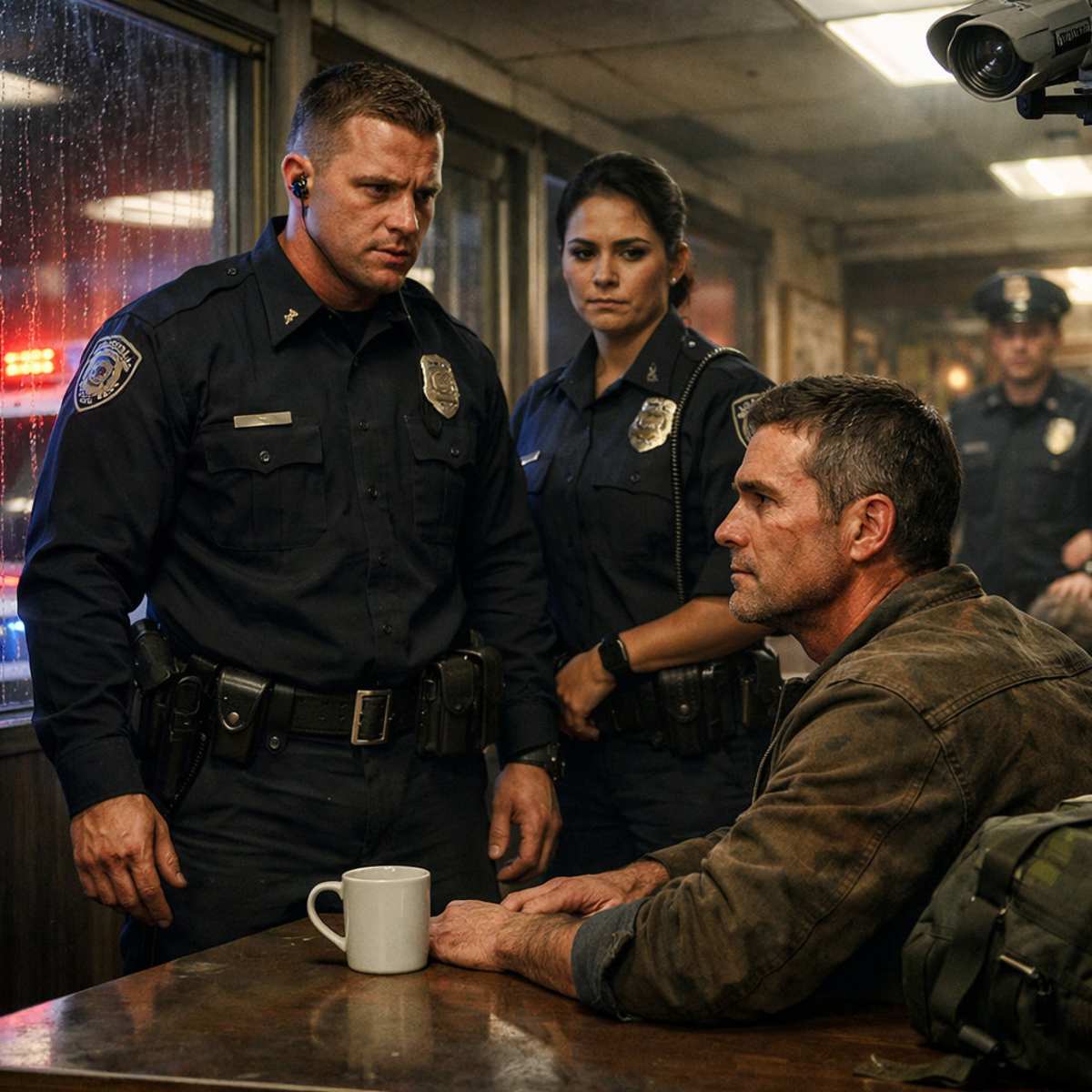
A fight breaks out in a diner. Nothing unusual there. Anyone who has spent time around police work knows that diners, bars, and late-night food joints are magnets for trouble. A drunk grabs a waitress named June. A man named Dax Hollis steps in and stops it.
End of story, right?
Except the police arrive seventy-four seconds later.
Seventy-four.
If you’ve ever called the police, you know how strange that is.
Most patrol units take several minutes to arrive even when they’re close. Dispatch has to receive the call. It has to be entered into the system. Units have to be notified. Officers have to acknowledge the call and start moving.
That process takes time.
But in Meridian the cruisers don’t arrive late. They don’t even arrive on time.
They arrive almost instantly.
Two cars. Opposite directions. Perfect timing. No sirens. Just lights washing the diner windows in red and blue like a warning signal.
Then the officers step out.
And something about them feels off.
They move with a kind of precision that feels rehearsed. Not the loose, tired movement of patrol cops who have been working a long shift. Their uniforms look brand new. Their gear hangs perfectly on their belts.
Four officers walk in.
Two secure the door.
Two move inside.
Their eyes don’t scan the room. They don’t check on the drunk man bleeding at the counter. They don’t ask the waitress if she’s okay.
They go straight to Dax Hollis.
That’s the part that should make you pause.
Because in most real situations, the first questions would go to the victim. The waitress who had been grabbed. The drunk who started the fight. The witnesses at the counter.
Instead the officers focus on the one man who stepped in to stop it.
Hollis.
They already seem to know exactly where he’s sitting.
They already seem to know who he is.
And while the officers talk to him, a security camera above the register pivots with a quiet mechanical whir.
Tracking him.
Watching.
If you read crime fiction long enough, you start to notice the little details. The things that feel just a little too precise. A response time that doesn’t make sense. Officers who seem less interested in a crime than in a particular person.
That’s when you start asking the same question the characters eventually will.
How did they get there so fast?
And more importantly:
Why were they already looking for Hollis?
Because when the police arrive seventy-four seconds after a fight ends, it raises a possibility that should make anyone uneasy.
Maybe the system didn’t respond to the incident.
Maybe the system was already watching.
And if that’s true, then the real question becomes:
What the heck is going on in Meridian?
(Image: From the upcoming novel The Zero Index, coming soon)