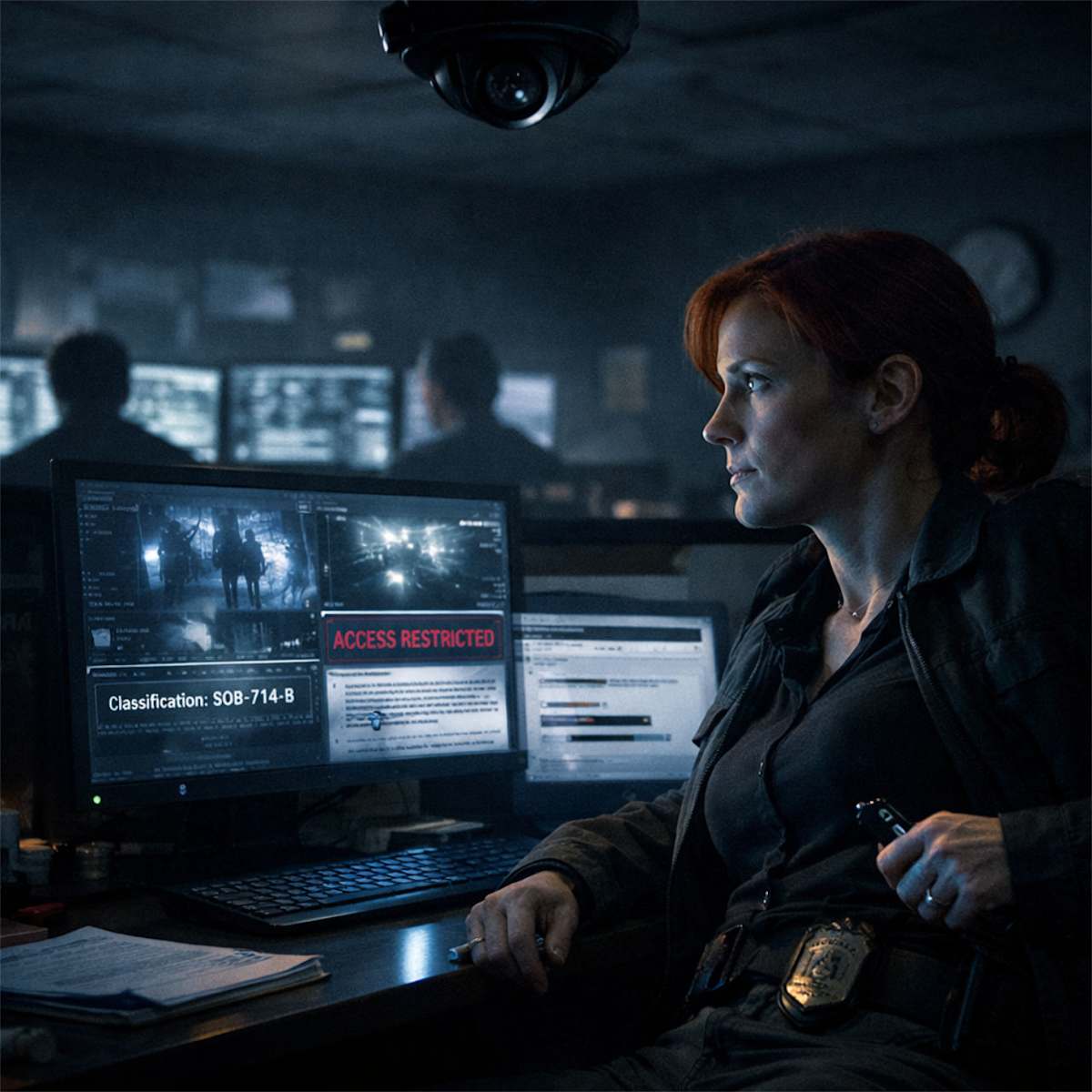
(Image: Scene from Chapter 11 of The Zero Index)
A thought that led to Chapter 11 of The Zero Index
There’s a moment in Chapter 11 of my upcoming technothriller The Zero Index that kept me staring at my keyboard longer than usual.
Not because it was hard to write.
Because it felt a little too close to reality.
In the scene, Detective Rachel Carter returns to her precinct during the night shift. The building looks exactly the way police buildings always look late at night—half lit, quiet, coffee growing stale in paper cups.
The day officers are heading out. The night shift is settling in.
Routine handoffs.
A few tired jokes.
The familiar rhythm of people who have done this job for years.
No one says anything about the tactical team that stormed an apartment earlier that evening.
No one asks Carter about the operation.
No one mentions her meeting with Lang.
If reports were written about what happened earlier that night, they’re not moving through the system the way reports normally do.
That’s the first clue something is wrong.
In police departments—and really in any large institution—information rarely disappears.
It gets logged.
Filed.
Archived.
Systems are built for that purpose.
But Carter decides to check the security footage anyway.
And that’s when things begin to feel… off.
The video from the apartment building where the operation occurred looks degraded.
Not broken.
Edited.
One camera shows six minutes of static.
Another shows flashes of black SUVs and tactical gear—faces blurred just enough that no one can be identified.
Then Carter notices the time codes.
They’re skipping.
Entire minutes vanish between frames.
Inside the building the footage is worse. The hallway camera outside the apartment should show the entire operation.
Instead it shows fragments.
Moments missing.
And when a man named Hollis steps into frame—the moment the situation begins to unravel—the video distorts and the audio cuts completely.
But the detail that finally unsettles Carter is something else.
In several frames…
she’s been altered in the footage.
Her figure is smaller.
Her face blurred.
Anyone reviewing the video later would assume she was never there.
The official incident report isn’t much better.
No department letterhead.
No officer signatures.
No case numbers.
Just a sterile entry under a classification code.
The report claims it was a routine security sweep responding to an alert.
It states that unidentified individuals fled the scene.
It says no civilians were present.
According to the system, nothing unusual happened.
The system didn’t just observe the event.
It rewrote it.
That idea—the idea that systems can quietly reshape reality—was the spark for the scene.
And the reason it stuck with me is simple.
We already rely on systems like this every day.
Not sinister ones.
But automated ones.
Systems that record, filter, compress, redact, and sometimes quietly alter the information we depend on.
For example:
Video surveillance systems automatically compress footage to save storage space. When bandwidth drops, frames are removed or blended together. Entire moments can disappear in the process.
Body cameras used by police often rely on pre-event buffers and automated activation triggers. If the trigger fails or the buffer overwrites itself, the crucial moments before an incident may simply not exist in the recording.
Email security systems routinely filter, quarantine, and sometimes delete messages before the recipient ever sees them. Entire conversations can vanish because a machine classified them as suspicious.
Content moderation systems on social platforms automatically remove posts, hide comments, or shadow-limit visibility using algorithms that few people fully understand.
Financial systems flag transactions as fraud and temporarily freeze accounts with no human involved in the initial decision.
Search engines constantly re-rank results using algorithms that determine what information appears—and what information effectively disappears.
Even something as simple as cloud storage versioning can overwrite earlier files without users realizing it, leaving the most recent version as the only surviving record.
None of these systems are inherently malicious.
Most of them exist to make things work more efficiently.
But they all share something important in common.
They quietly shape the records we trust.
They decide what is preserved.
What is compressed.
What is filtered.
And sometimes what is erased.
Thrillers often ask a simple question and then push it to its extreme.
For The Zero Index, the question is this:
What happens when the system that records reality becomes the system that edits it?
Not a hacker deleting files.
Not someone breaking into a database.
But a system designed to make information cleaner, simpler, more efficient—slowly rewriting events as it processes them.
In the novel, Carter begins to realize she’s trapped inside a system that has been quietly adjusting the record of what happened around her.
Evidence disappears.
Reports change.
Access points close.
The more she looks, the more the system seems to anticipate her.
That’s where the thriller begins.
Because the real fear isn’t that someone is watching.
The real fear is something stranger.
Something quieter.
What if the system can make it look like something never happened?
No footage.
No report.
No record you were ever there.
That idea is what sits at the center of The Zero Index.
And the closer I look at the systems we already depend on every day, the less fictional that question feels.
The novel is coming soon.
But the conversation around that question is already here.
Because in a world run by digital systems…
who controls the record of reality?