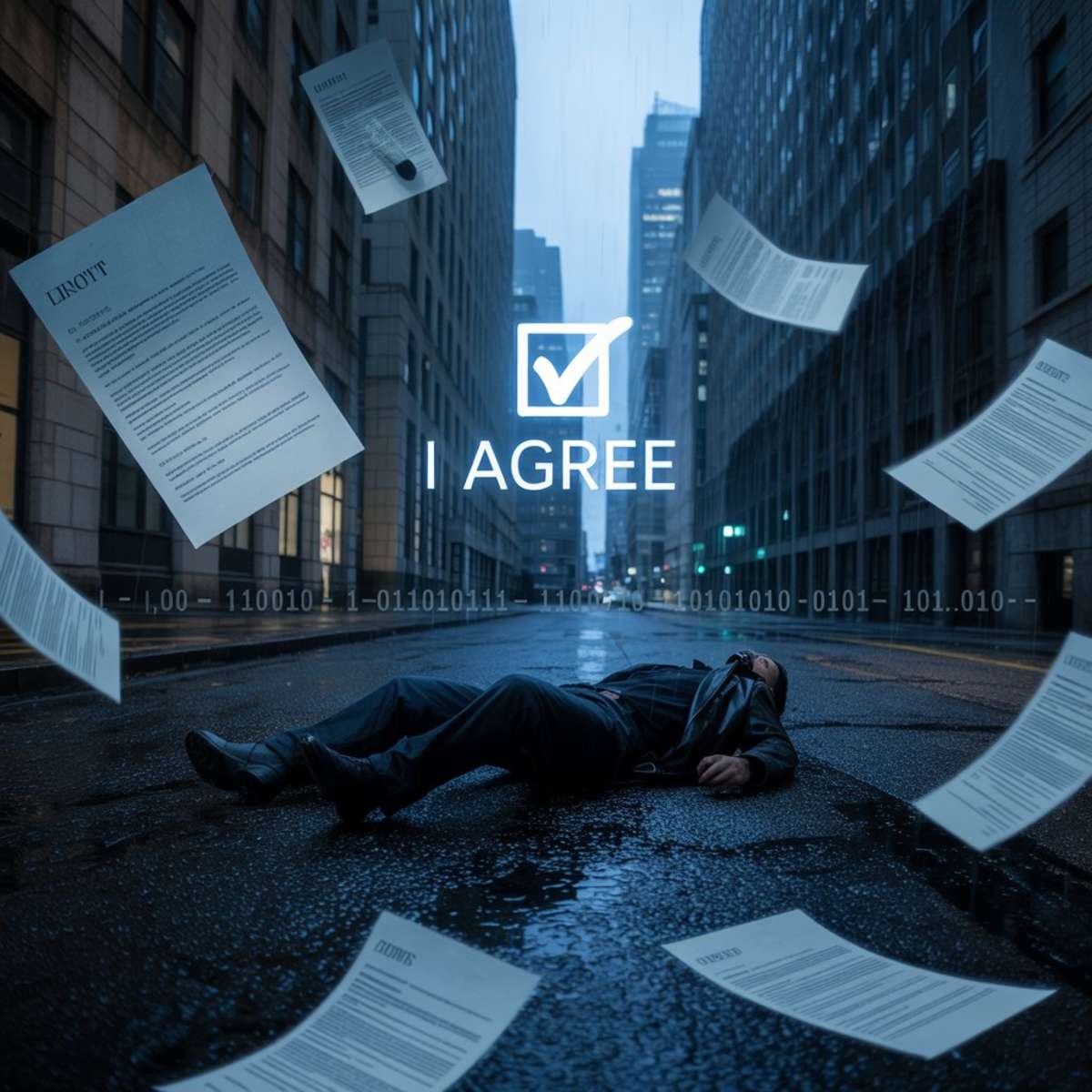
There’s a moment—usually around the third paragraph of something called “Terms & Conditions”—when the human brain quietly checks out.
You’ve been there.
The box is small. The font is smaller. The sentences stretch on like a Midwestern highway in August, no exits in sight. Words like indemnify, irrevocable, perpetual license, binding arbitration. You scroll. You don’t read. You click.
I Agree.
It’s the most casually dangerous phrase in the English language.
Because almost no one reads the small print. Not really. We tell ourselves we will. We skim the first line, maybe the bolded header. But comprehension? Understanding? That’s another country entirely. And we don’t have the time. We have dinner to cook. Emails to answer. A meeting in ten minutes. The world hums along on frictionless convenience, and the price of admission is always the same:
Click here.
Now here’s the question that keeps me up at night, the one that found its way into my upcoming novel The Consent File:
How can consent be real if it isn’t understood?
Consent without understanding is theater. It’s a performance staged in twelve-point font. It’s the illusion of choice dressed up as autonomy.
We like to believe consent is sacred. Clean. Binary. Yes or no. But what if “yes” is buried under forty-seven clauses written in language designed less for clarity than for protection? What if the small print is so dense with legal smoke that even the educated reader walks away blinking?
If informed consent were truly the goal, wouldn’t it be… understandable?
Wouldn’t it be written in language your grandmother could read without reaching for a dictionary?
Instead, the small print is a labyrinth. And the Minotaur at its center isn’t some horned monster. It’s data.
Because here’s where it gets unsettling.
We don’t just agree once.
We agree every day.
We agree to the fitness app that tracks our heart rate at 2:13 a.m.
We agree to the grocery service that learns what we crave.
We agree to the rideshare that maps our movements.
We agree to the mental health questionnaire that asks how often we feel “persistent dread.”
We agree to the financial app that categorizes our spending into neat little boxes labeled stress, impulse, routine.
Each agreement feels small. Harmless. Isolated.
But layer them together?
That’s where the story turns dark.
Because consent permissions don’t live alone. They stack. They overlap. They cross-reference. What one company knows about your sleep patterns, another knows about your spending habits. A third understands your search history at 1:47 a.m. when the house is quiet and your guard is down.
Individually, they’re puzzle pieces.
Together, they’re a portrait.
A vulnerability profile so precise it doesn’t just know who you are.
It knows where you’re weakest.
That’s what happened to Lucas Fenwick.
Lucas didn’t think of himself as careless. He paid his taxes. He updated his passwords. He clicked “Agree” the way the rest of us do—out of habit, out of trust, out of exhaustion. He believed consent meant control.
But the system understood something he didn’t.
When you layer permissions across platforms—biometric logs here, geolocation there, behavioral risk scores somewhere else—you don’t just create a consumer profile.
You create leverage.
In The Consent File, Lucas becomes the victim of a world that didn’t need to break into his house. It already had the keys. His digital signatures, his behavioral analytics, his predictive risk assessments—all perfectly legal. All perfectly documented. All consented to.
The tragedy isn’t that he said yes.
It’s that he never truly knew what he was saying yes to.
And that’s the part that chills me.
Because murder, in fiction, is rarely just about blood on pavement. It’s about systems. It’s about the quiet machinery that hums beneath the surface of ordinary life. The machinery we trust because it looks official. Because it uses formal language. Because it tells us everything is secure.
Until it isn’t.
We live in an age where consent has become currency. We trade it for speed, for access, for convenience. But if that consent is buried in jargon, obscured by complexity, stretched across multiple entities until it forms a latticework of exposure—
Was it ever informed?
Or was it simply… harvested?
The scariest monsters aren’t the ones hiding under the bed. They’re the ones hiding in plain sight, tucked neatly beneath a checkbox and a blue button that says:
Accept All.
And somewhere, right now, someone is clicking it.
Without reading a word.