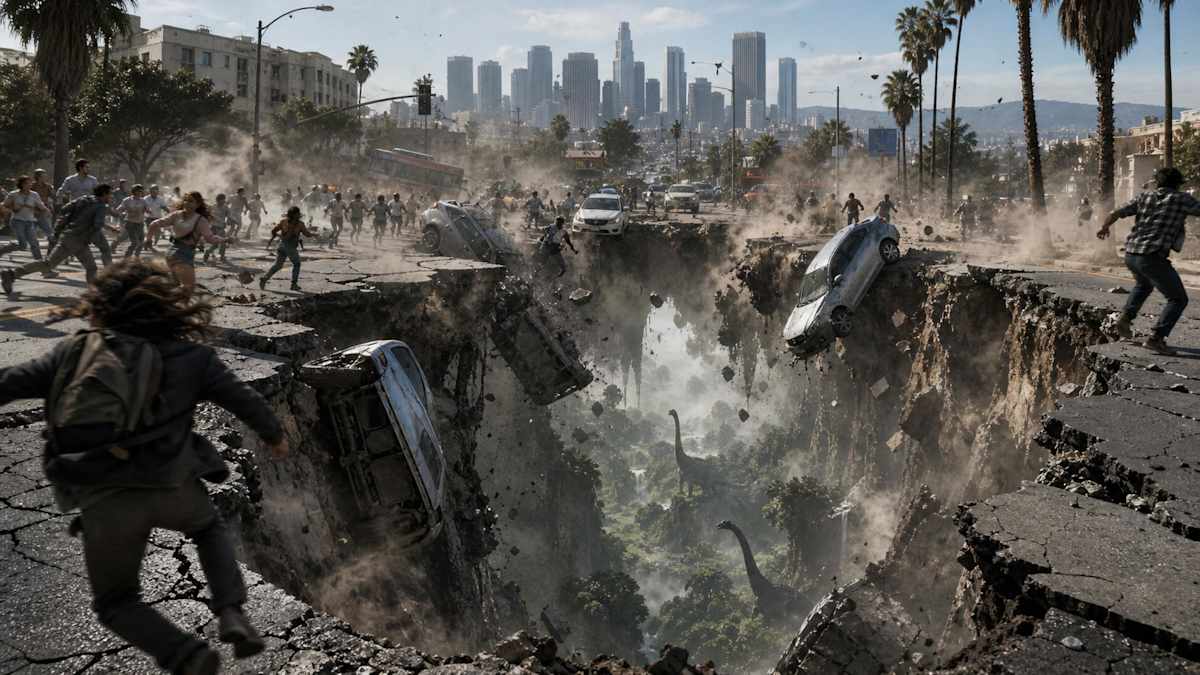
La Brea is one of those shows that sounds ridiculous until you realize how brutally effective the premise is.
A massive sinkhole opens in Los Angeles. Cars vanish. Buildings crack. People fall screaming into the earth. Then the impossible twist lands: they are not dead. They have fallen into a dangerous prehistoric world.
Below, I’m embedding the first five minutes of Season 1, Episode 1, because that opening sequence is the whole sales pitch. You do not need a long explanation. You do not need a mythology lecture. You see the ground split open, you see ordinary life become impossible, and you instantly understand the question driving the show:
What if the world literally opened under your feet?


La Brea originally aired on NBC from 2021 to 2024, running three seasons and 30 episodes. Netflix has now licensed all three seasons in the U.S., with the full series arriving on May 1, 2026. It is not a Netflix revival, at least not right now. Netflix did not “rescue” it for a new season. What Netflix did was give the completed NBC series a second life in the exact place where shows like this often perform best: binge streaming.
And that second life appears to be working fast. As of May 2, 2026, FlixPatrol listed La Brea as the number three TV show on Netflix in the United States, right behind Should I Marry A Murderer? and Man on Fire.
That is not hard to understand.
La Brea has the kind of premise Netflix viewers love to click on. It is high-concept, instantly visual, easy to describe, and loaded with cliffhangers. You can sell it in one sentence: a sinkhole swallows part of Los Angeles and drops the survivors into a primeval world.
That is the first lesson for writers.
A strong premise does not need a paragraph to explain itself.
The show opens with an ordinary morning. Traffic. Family tension. A drive through Los Angeles. Then the city breaks. That contrast matters. Disaster works best when it interrupts routine. If the scene begins already strange, the audience has no baseline. But if the scene starts with school, errands, traffic, and family stress, then the impossible event feels like a violation.
The sinkhole is not just spectacle. It is a story engine.
It separates families. It creates survival stakes. It divides the narrative between the people who fell and the people left behind. It forces strangers into alliances. It introduces a mystery larger than the disaster itself. In writing terms, the sinkhole is the inciting incident, the antagonist, the portal, and the metaphor all at once.
That is why the opening works even if you are not usually a network sci-fi viewer. It gives the audience a clean emotional problem before it gives them a lore problem.
A weaker version of La Brea would start with scientists discussing anomalies, government agencies hiding files, or someone explaining temporal instability. La Brea starts with bodies falling. That is much better.
The show uses the oldest trick in speculative fiction: take something familiar and make it impossible.
Los Angeles is familiar. Traffic is familiar. The La Brea Tar Pits are real. The idea of the ground opening is terrifying because it attacks a basic assumption. The street is supposed to hold. The city is supposed to stay where it is. The world under your feet is not supposed to have teeth.
This is one of the reasons the show connects with streaming audiences. It does not ask viewers to learn a fictional kingdom, a glossary of terms, or a complicated political system before the story begins. The hook is physical. The image does the work.
Then the show adds mystery.
Where did they go?
Why did they survive?
Can the people above reach them?
Are the visions connected?
Is this disaster natural, supernatural, scientific, or engineered?
Those questions create what writers often call narrative propulsion. The viewer may not be watching because every answer is brilliant. They are watching because the show keeps opening doors. Mystery-box storytelling can frustrate audiences when it becomes empty teasing, but it is incredibly powerful when attached to primal stakes. La Brea works because the mystery is tied to survival and family reunion.
The show also uses separation as an emotional device.
The Harris family is split between worlds. Eve and Josh fall through. Gavin and Izzy remain above. That creates parallel storylines with mirrored urgency. Below, the survivors need food, safety, medicine, and answers. Above, the family members and authorities need proof, access, and belief.
This is smart because a disaster without intimacy becomes noise. Buildings collapse, crowds scream, CGI roars, and after a while the viewer goes numb. La Brea narrows the chaos into a family wound. The world cracks open, but the emotional question is simple:
Can this family find its way back to each other?
That is why the show does not need prestige-TV subtlety to be effective. It is built on big, clean, old-school storytelling: disaster, separation, survival, mystery, reunion.
Writers can learn a lot from that.
First, start with a visual hook.
The sinkhole is not abstract. It is not “a mysterious anomaly.” It is a hole in Los Angeles swallowing people alive. Readers and viewers remember images before they remember explanations. If your story can be reduced to one unforgettable image, you are in stronger territory.
Second, make the impossible personal.
A city falling into a prehistoric world is spectacle. A mother and son separated from the rest of their family is story. The audience needs both, but the personal stakes are what keep the spectacle from becoming disposable.
Third, let the inciting incident do more than one job.
The sinkhole creates danger, mystery, worldbuilding, character separation, survival pressure, and a ticking clock. That is efficient storytelling. The best inciting incidents do not just start the plot. They transform the entire structure of the story.
Fourth, delay the explanation.
The opening does not stop to explain the science. It lets confusion become part of the experience. That is a useful lesson for thriller, horror, and sci-fi writers. You do not always need the audience to understand the event immediately. You need them to care enough to chase the answer.
Fifth, use contrast.
Modern city versus primeval wilderness. Family routine versus mass disaster. Government procedure versus impossible evidence. The more extreme the contrast, the easier it is for the audience to feel the rupture.
La Brea also leans into several classic literary devices.
The sinkhole functions as a portal. Like the wardrobe in The Chronicles of Narnia or the tornado in The Wizard of Oz, it moves characters from the known world into the unknown. But this version is violent. No one chooses the journey. They are taken.
It also works as a metaphor. The ground opening beneath Los Angeles externalizes instability. The modern world looks solid until it is not. Families look intact until stress reveals the fractures. Civilization looks permanent until nature, time, or something stranger tears through the pavement.
The show uses dramatic irony as well. Some characters above the sinkhole believe the victims are dead. The audience knows they are alive somewhere else. That gap creates tension. We are waiting for the truth to cross worlds.
It uses cliffhangers constantly. That is one reason it fits streaming so well. Network television had to pull viewers from week to week. Netflix lets those same hooks pull viewers from episode to episode. The machinery is the same, but binge watching makes it feel faster.
And finally, La Brea uses escalation. The first question is “What happened?” Then it becomes “Where are they?” Then “How can they survive?” Then “Can they come home?” Then “What caused this?” Each answer opens a bigger problem.
That is the secret behind a lot of popular genre storytelling. The audience does not need perfection. They need momentum.
La Brea became easy to mock during its NBC run because it is big, pulpy, earnest, and sometimes gloriously absurd. But that is also why it works on Netflix. Streaming audiences often want a show that moves. They want a premise they can understand in ten seconds. They want danger, secrets, family stakes, and enough unanswered questions to justify one more episode.
La Brea gives them that.
For writers, the lesson is not to copy the sinkhole. The lesson is to study the function of the sinkhole.
Find the image that breaks the world.
Tie it to a character wound.
Separate people who need each other.
Make the audience ask a question they cannot ignore.
Then keep making the answer more dangerous.
That is why La Brea still has life after NBC. Netflix did not just pick up an old network sci-fi show. It picked up a premise that never stopped being clickable.
The earth opens.
People fall.
And suddenly, everyone wants to know what is waiting underneath.