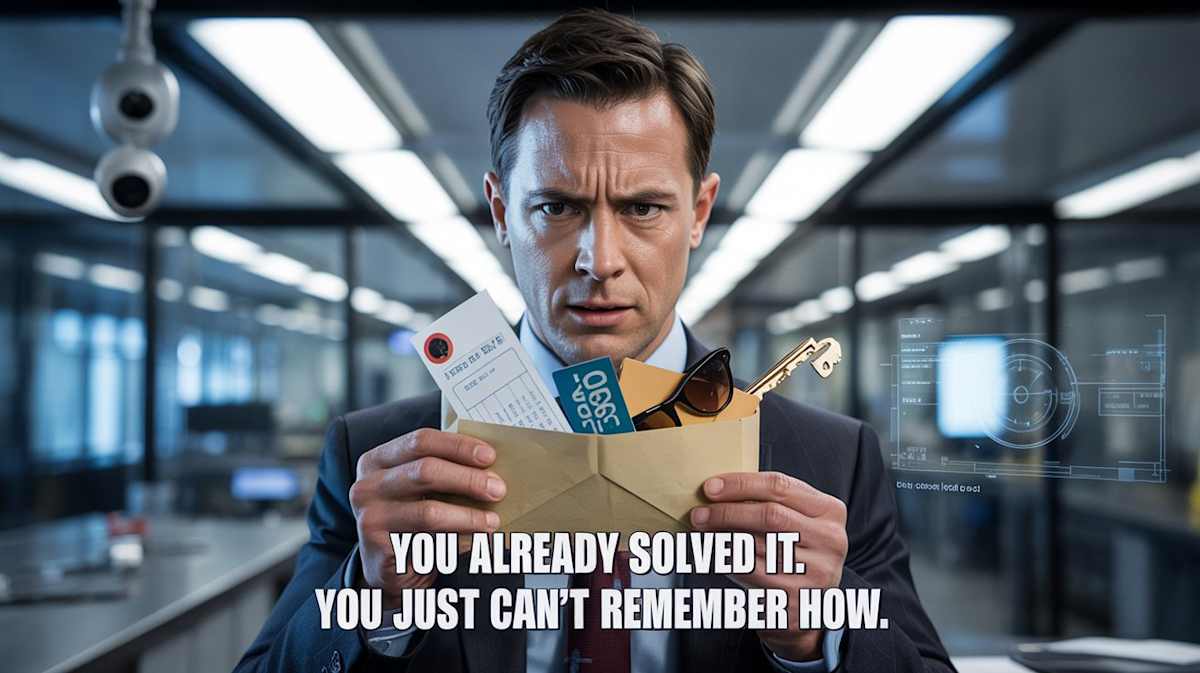
There’s something quietly dangerous about a story that takes knowledge away from its own protagonist.
Not hides it. Not delays it.
Erases it.
That’s the engine driving Paycheck, the 2003 sci-fi thriller starring Ben Affleck and directed by John Woo. Based on a short story by Philip K. Dick, it takes one of the oldest narrative tools in storytelling, limited information, and weaponizes it against both the character and the audience.
If you’re writing thrillers, sci-fi, or anything rooted in mystery and tension, this movie is a blueprint hiding in plain sight.
Let’s break down what makes it work, and what you can steal from it. But first, here's the full movie you can watch.


The Premise: A Man Who Can’t Remember… But Somehow Planned Everything
Michael Jennings (Ben Affleck) is a reverse engineer who gets paid to work on cutting-edge tech projects, then has his memory wiped afterward to protect corporate secrets.
One job goes longer than expected. Eight months.
When he wakes up, his paycheck, worth millions, is gone. In its place?
A random envelope of everyday objects.
A bus ticket. A paperclip. A pair of sunglasses.
Worthless.
Until they start saving his life.
This is the core genius of the story: the protagonist has already solved the problem… but doesn’t remember how.
So now he has to follow breadcrumbs left by a version of himself that knew the future.
1. The “Closed Loop” Narrative (Cause and Effect on Steroids)
At the heart of Paycheck is a closed-loop structure, a form of causality where the future influences the past, and everything that happens is both a result and a cause.
This creates a powerful narrative effect:
- Every object has meaning
- Every moment feels pre-determined
- Every action tightens the net
From a writing standpoint, this is cause-and-effect storytelling pushed to its limit.
Nothing is random.
Even when it looks random.
The audience learns to trust that everything matters—which creates tension in even the smallest details.
Lesson for writers:
If you want readers locked in, design your story so that nothing can be ignored. When every element might be the key, attention becomes survival.
2. The “Mystery of Self” (Internal Conflict as External Plot)
Most thrillers pit the protagonist against an external force.
Paycheck does something more interesting:
The protagonist is chasing… himself.
- Past self = the architect
- Present self = the detective
This creates a layered conflict:
- He doesn’t trust the people around him
- He can’t trust the system
- He isn’t even sure he can trust his own decisions
That last one is where the story gets sticky.
Because if you made these choices… what kind of person were you?
Literary device in play:
- Unreliable identity (a variation of the unreliable narrator)
The character isn’t lying.
He’s incomplete.
Lesson for writers: You don’t need multiple characters to create tension. Split a single character across time, memory, or perspective, and let them interrogate themselves.
3. Chekhov’s Gun… Everywhere
You’ve heard the rule: If a gun appears in Act 1, it must go off by Act 3.
Paycheck turns that into a full narrative system.
Every item in the envelope is a Chekhov’s object:
- The paperclip isn’t a prop, it’s a solution
- The sunglasses aren’t style, they’re foresight
- The ticket isn’t travel, it’s timing
This does two things:
- Creates anticipation
- Rewards attention
The audience is constantly asking: Why would he give himself this?
And when the answer lands, it feels earned.
Lesson for writers: Don’t just plant objects, assign them future consequences. Make readers subconsciously track everything.
4. Information Control (The Real Engine of Tension)
This story works because it controls who knows what, and when.
- The audience knows as much as Jennings
- Jennings knows less than his past self
- The villains may know more—or think they do
That imbalance creates constant instability.
You’re never grounded.
You’re always catching up.
This is classic dramatic irony inverted: Instead of the audience knowing more than the character, the character used to know more than both. And now no one does.
Lesson for writers: Tension isn’t just about danger, it’s about information imbalance. Decide who’s blind, who’s ahead, and who’s guessing.
5. The Philip K. Dick Core: Reality Is Not Stable
Because this is rooted in a Paycheck story, it carries Dick’s signature theme: Reality isn’t something you experience. It’s something that’s been manipulated.
In Paycheck, that manipulation comes through:
- Memory erasure
- Corporate secrecy
- Predictive technology
But the deeper question is philosophical:
If your memories are gone… are your choices still yours?
This elevates the movie beyond action.
It becomes existential.
Lesson for writers: A thriller hits harder when the stakes aren’t just physical, but identity-level. Ask what your story is really destabilizing.
6. Why It’s Still Popular
Despite mixed critical reception at release, Paycheck has stuck around, and there’s a reason:
- The concept is instantly understandable
- The mystery unfolds through action, not exposition
- The structure rewards rewatching
- The “object puzzle” is deeply satisfying
It’s a high-concept premise executed through tangible storytelling.
No lectures.
No dense explanations.
Just: Here’s a thing. It will matter. Watch.
That’s a powerful contract with the audience.
Final Takeaway: Design the Story So the Past Hunts the Present
What Paycheck gets right is something many thrillers miss: It doesn’t just move forward. It folds back on itself.
The protagonist isn’t just reacting to events, he’s following a trail laid by a version of himself who already survived them.
That creates inevitability.
Momentum.
And a constant question humming underneath every scene: If I already made these choices... what did I know that I don’t now?
For writers, that’s the gold.
Because once your story makes the reader ask that question, they’re not just reading anymore. They’re trying to solve it.